Tag: Travel

  • Salmon, Sweetgrass, and Reciprocity in the Age of Exploitation

    Salmon, Sweetgrass, and Reciprocity in the Age of Exploitation

    There’s a place on Earth where trees grow tall as towers, their branches caressing the sky like fingers. 

    Beneath this verdant canopy, ocean fog drifts between trunks, saturating everything in a cool, dreamlike glaze. Moss is ubiquitous, covering trunks and boulders the size of cars in velvet green coats, while ferns blanket the ground, sheltering beneath the shade of the giants around them. Within this rich ecosystem, animals are as abundant as plants. Mother bears with cubs lumber around looking for food. Otters paddle and twirl through mountain rivers. And salmon—colorful and essential to this region’s wellbeing—splash hundreds of miles upstream to spawn.

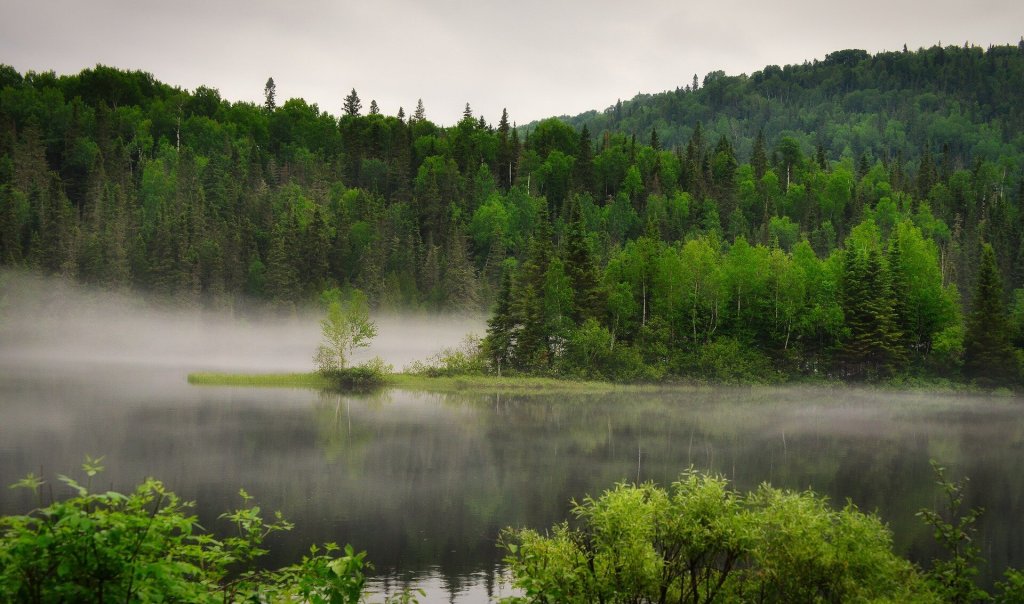
    Oregon Rainforest
    An Oregon rainforest. (Thomas Shahan, Flickr)

    Salmon are a keystone species in the lush landscapes of the Pacific Northwest. While most aquatic animals live in saltwater or freshwater environments, salmon can survive in both. Every year, they travel from their ocean homes to streams, rivers, and lakes to lay eggs, passing through estuaries along the way. Salmon depend on these brackish halfway points; within them, their bodies undergo physiological changes that prepare them for their freshwater forays.

    As the migrating salmon move inland, bears, eagles, and humans feast on them, leaving their fishy carcasses within the dense undergrowth after eating their fill. Over time, the volume of briny, decomposing bodies introduces substantial amounts of nitrogen to these freshwater ecosystems, thus nourishing not only predators, but plants, too.

    Sammamish kokanee
    A Kokanee salmon in the Lake Sammamish watershed. (USFWS – Pacific Region, Flickr)

    The salmon that make it to the spawning grounds lay thousands of eggs, only to die shortly after in a final act of poetic significance—their life’s purpose now complete.

    Anthropic Narcissism 

    While salmon are crucially important to the environment, their population has plummeted in recent centuries. 

    As settlers replaced Indigenous peoples, harvest goals shifted from sustenance to profit, with little regard for population integrity. Grazing space became another priority, since settlers also brought herds of cattle with them. Thus, estuaries—some of the most productive ecosystems on the planet—became obstacles, and people got to work dredging, damming, and otherwise eliminating them. Without these vital pathways and rest stops, salmon could no longer migrate, nor feed anyone.

    Scientists estimate that in the past, between sixteen to twenty million salmon migrated inland across the Pacific Northwest each year; now, that number is around one million.

    Once the ecological role of salmon and was understood, conservation efforts like the Endangered Species Act were implemented. Today, the ESA protects twenty-eight Evolutionary Significant Units of Pacific Northwest salmon and steelhead, providing support for recovery plans, hatchery programs, and habitat restoration efforts.
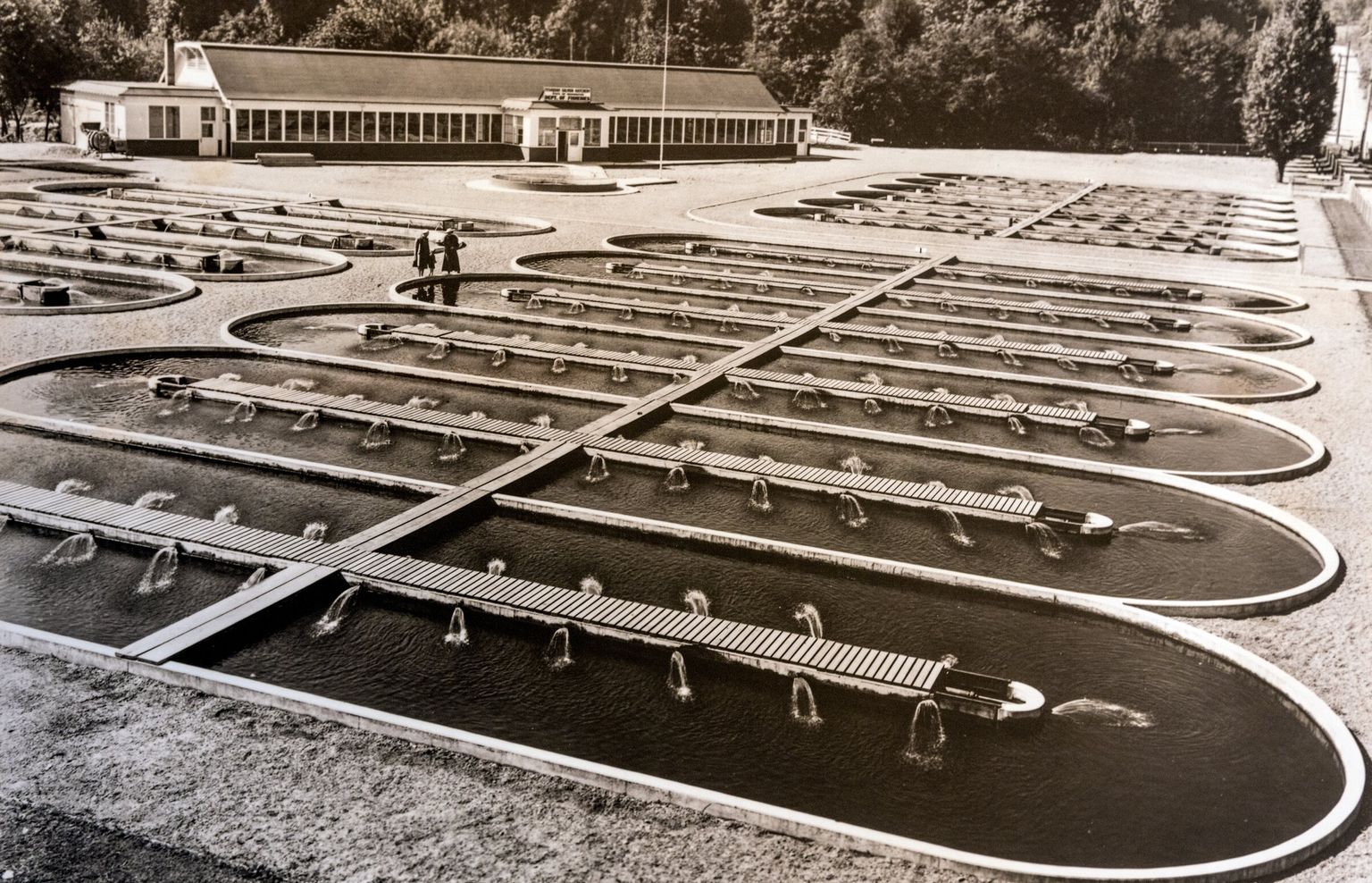
    The Issaquah Salmon Hatchery, 1936. (The Seattle Times)

    Unfortunately, both Trump administrations have been not just unfriendly to salmon (and myriad other endangered species), but outright hostile. From abandoning climate pledges to rolling back protections on clean air and water, officials are wrecking the planet with a degree of tenacity only possible thanks to their incessant misinformation campaigns. The ESA, in particular, has sustained repeated attacks, opening the door to renewed habitat destruction and population endangerment. While a federal court struck down the Administration’s most recent assault on the ESA, subsequent attacks will doubtlessly follow, and their repercussions will extend far beyond salmon.

    From monarch butterflies to California spotted owls and Florida panthers, the anthropic narcissism that defines our times impacts all threatened and endangered species, as well as the countless others that depend on them.

    Rage and Gratitude

    When reading these sorts of stories, itʻs hard not to feel rage.

    Rage at the hubris of the rich, content to sleep in beds of money while they destroy the planet. At the arrogance of settlers, who thought they understood lands better than the Indigenous peoples who’d resided on them for millennia. And rage at ourselves—at each of us, in our way—for our complicity in ecocide.

    But while we should feel rage over salmon deaths, over gray whale starvation and golf courses, over the pollution of sacred lakes and rivers and so much more, anger isn’t enough. We need something more powerful than rage—a paradigm shift in our collective thinking that can help us reharmonize with the natural world. For help, it’s worth turning to the work of botanist and author Robin Wall Kimmerer.

    In her book Braiding Sweetgrass, Kimmerer introduces numerous plants, highlighting their ecological benefits alongside their roles in Native cultures. But she also argues that seeing plants solely as oxygen-producing climate regulators hampers our ability to fully appreciate them. While grasses, shrubs, trees, mosses, and non-vascular varieties, such as fungi and lichens, are essential to the environment, they’re also complex organisms deserving of our respect.

    Kimmerer leading a class in upstate New York. (SUNY College of Environmental Science and Forestry)

    Fruit trees, to take an example from the book, communicate with one another via pheromones, debating when to produce fruit and then doing so, collectively, once consensus is reached. Besides overwhelming would-be-fruit-eaters, this release of airborne volatile organic chemicals (VOCs) allows for the discussion of other matters, such as pest invasions and when nearby trees should activate their defense systems. Meanwhile, beneath the earth, mycorrhizal fungi networks connect root systems, allowing trees to send direct signals about diseases, droughts, and other threats. By using this underground web, established trees can even share nutrients like carbon, helping others—particularly younger saplings—grow strong.

    From cedar trees in the Pacific Northwest to the mangroves of the Everglades, the trees around us aren’t isolated organisms—they’re part of a vast, interdependent network of shared abundance.
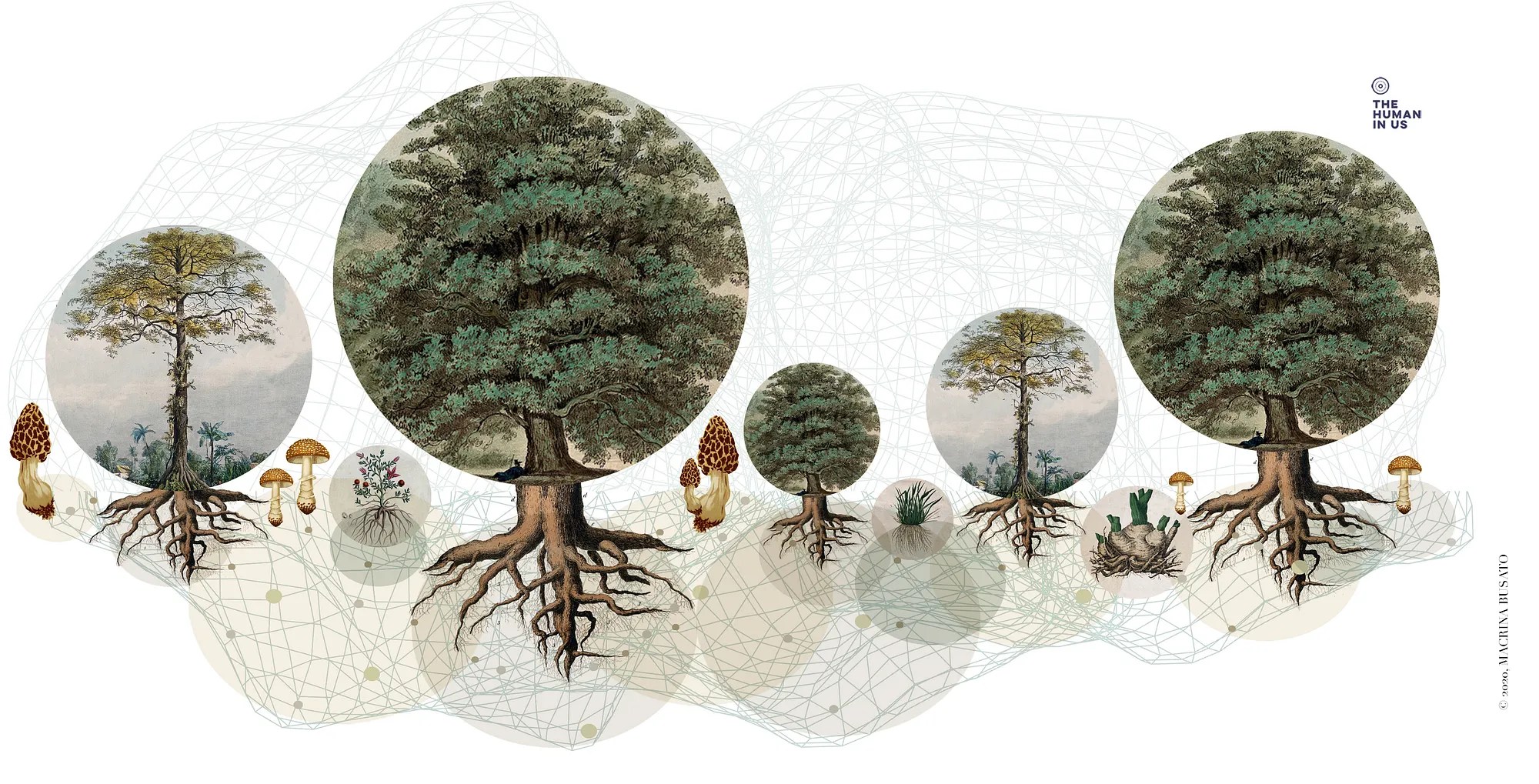
    An illustration of the “internet of trees.” (Macrina Busato)

    Then there are agricultural plants, which humanity has depended on for sustenance for twelve thousand years. Today, corn, rice, wheat, and similar plants cover one-tenth of the earth, supplying the staples that stock grocery store shelves around the world. Coated in plastic and disposed of, if they don’t sell, our global supply system makes it easy to take the food we eat for granted, while having us believe that we’ve domesticated this critically important group of species. But as we’ve propagated, irrigated, fertilized, weeded, and pruned on their behalf for millennia, it may be more apt to say that they’ve domesticated us. 

    And lichens, some of the simplest forms of life, in many ways, aren’t one organism, but two. Each lichen is comprised of a fungus and an alga—two beings that work alongside each other for survival. As the fungus “farms” the sugars produced by the alga, some scientists say that fungi were the first organisms to invent agriculture.

    Notably, efforts to recreate lichen in stable laboratory conditions are generally unsuccessful. Only when conditions become severe do the alga and fungus unite, individualism switching to reciprocity.

    Studying and observing the natural world allows us to deepen our appreciation for it, growing our relationship from textbook-level to gratitude. As Kimmerer explains, gratitude is essential because you don’t want to harm something you care about: You want to protect it.

    Collective Reciprocity

    Like the estuaries that salmon pass through, gratitude is a stop along the way to our final destination: reciprocity.

    This framework—of recognizing the bounty the natural world provides and showering it with gifts, in return—is another core theme of Kimmerer’s work. But reciprocity comes with a set of obligations, both on the individual and collective levels. 
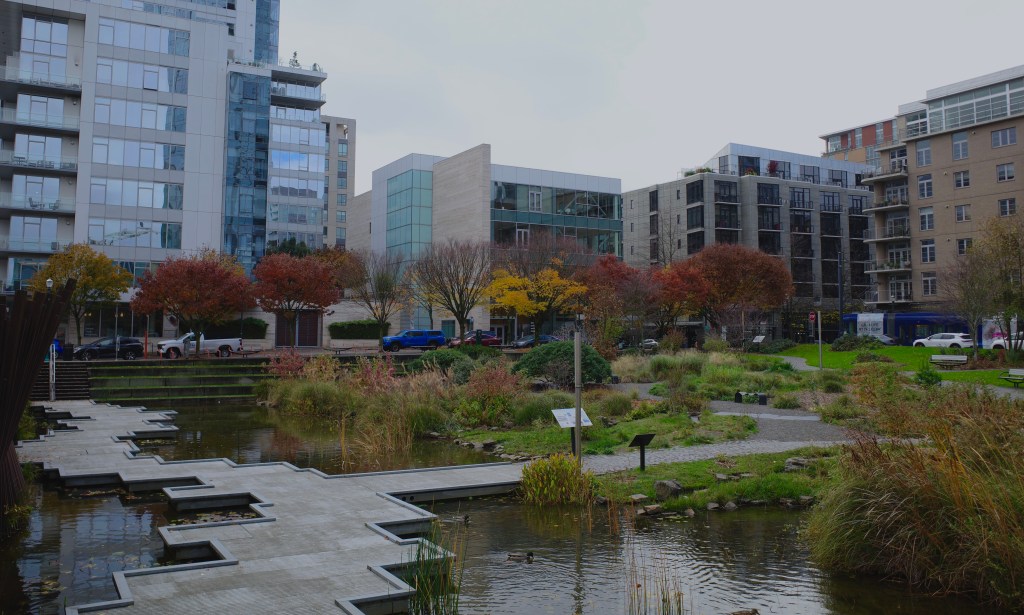
    Collective reciprocity at work. Tanner Springs Park, a native oak-prairie wetland in Portland, Oregon. (2025)

    As an individual, reciprocity means using the tools and resources at your disposal to give back. If you’re a writer, that might mean using your voice to shed light on topics ranging from ecological issues to enshittification. If you’re an educator, it may involve fostering the innate care and compassion of your students. And if you’re a member of the working class, trying desperately to make ends meet while being one paycheck away from disaster, reciprocity can be as simple as recognition: acknowledging what nature provides and giving thanks to it, in return. 

    But individual actions, while meaningful, aren’t enough.

    Collectively, we’ve chosen to distance ourselves from reciprocity, choosing instead to embrace its ugly opposite: exploitation. Modern business schools teach students that our planet offers a bounty, yes—but one that translates to infinite economic growth. Corporations are not just permitted, but expected to rake in profits while laying waste to the planet. And our politicians care little for fish, plants, or constituents, focusing their attention, instead, on lobbyists and their reelections. As a species, we’ve tacked price tags onto everything, and the commons exist—be they forests, foreign fossil fuels, or whales—for extraction. 

    The Tragedy of the Commons: Deforestation in the Amazon. (AFP via Getty Images)

    Thus, returning to a place of gratitude and reciprocity begins with us viewing the world with less arrogance. Human ingenuity is remarkable, but we can’t allow it to morph into hubris, especially when thereʻs so much to learn from those around us.

    We may see fish as simple, but migratory species like salmon highlight the value of long-term, multi-generational thinking: After journeying for hundreds of miles, they trade their lives so that the next generation can survive. Trees might not have larynxes, but they communicate nonetheless, demonstrating how those who thrive have an obligation to help others (including other species) do the same. And lichens show us that when conditions worsen, cooperating with one another isn’t optional, but necessary.

    Of course, nature can appear cruel, and at times, cutthroat. But intense competition is usually a feature of young, developing ecosystems—not established ones with layers of checks and balances. A forest perennially at war with itself couldn’t survive; thus, scarcity and hoarding aren’t features of mature ecosystems.

    Abundance, on the other hand, is. 

    An old-growth forest in the Pacific Northwest. (U.S. Fish and Wildlife Service)

    A cutthroat economic system that devours and hoards is similarly unsustainable—for humans and the planet. Like a young forest, we should see the exploitation and competition of our times as features to shed on our path to maturity.

    Fighting for Abundance

    Alarm bells should be ringing. 

    Instead of fighting to preserve the climate and protect the species we cohabitate with, our government is driving us ever closer to the precipice. As we careen towards the edge, the effects of this recklessness are becoming increasingly apparent.

    Atlanta, where I live, recently endured a month-long drought. The rain that finally arrived was much-needed but, because of how dry the ground was, also triggered flood warnings across the region. Scorching heat has become common throughout the cooler months, and the increasingly powerful tropical storms that spin up the Atlantic coast have made conditions wetter, and thus more mosquito-ridden. Winters now feature warmer temperatures on average but are interspersed with sudden, polar vortexes that kill many of the Southern plants and animals unaccustomed to them.

    And, hard-to-believe as it may be, these changes pale in comparison to those felt in the Global South.
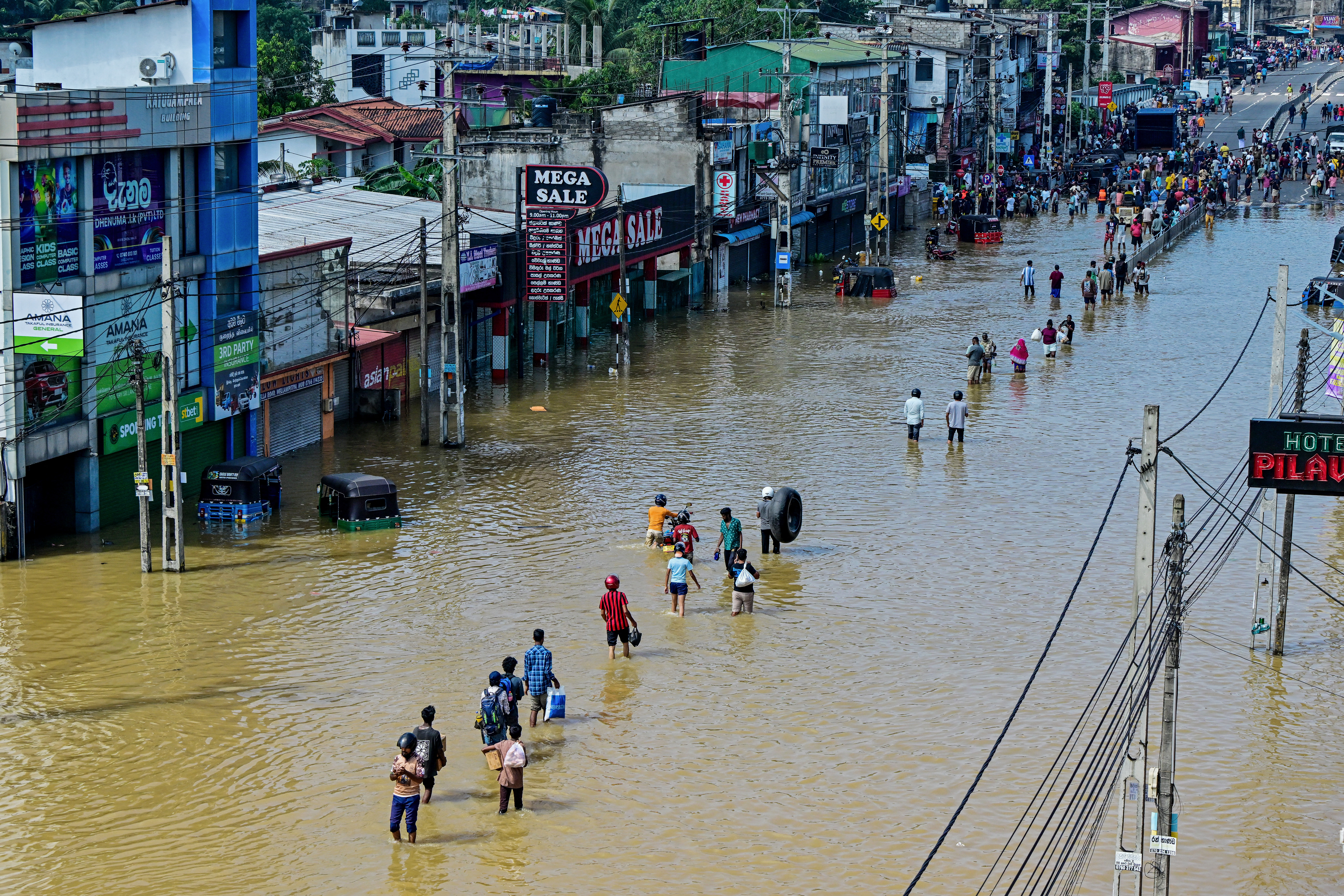
    The aftermath of a cyclone that hit Sri Lanaka, November 2025. (AFP via Getty Images)

    Fortunately, nature is resilient, and in the years ahead, humans will need to be too. 

    The lesson from the decimation of the Pacific Northwest salmon should be that no organism exists in isolation. We rely on one another, and when one species suffers, we all do. As our short-sightedness and greed exacerbate the climate catastrophe, the plants and animals around us will need our help more than ever. And, contrary to what the arrogant among us would have us believe, we will need theirs. 

    To survive, we need to return to practicing gratitude and reciprocity, as well as tear back the suffocating overgrowth of our current system—however daunting confronting the entrenched forces of money and power may be. Just as we now gaze back at institutions like slavery and wonder, what were people thinking, there will come a time when subsequent generations do the same—when our cruel, exploitative system is confined to textbooks, to be studied, with amazement, by people incredulous that their ancestors lived in a world that prioritized a fiction like money above their planet’s tangible wellbeing. 

    As we build new institutions that work to preserve life, we’ll mature from a group of competing saplings into a forest, transforming our world from one of scarcity to abundance. 
  • Transit Dreams: A Diary

    Transit Dreams: A Diary

    From Issue One of Alternative Webs, releasing soon.

    Atlanta

    I board the train, first taking in the smells. Old Spice and weed, most likely? It could be worse. A man sits near me, a full rotisserie chicken in-hand. That throws a new smell into the mix. We start moving as a static-garbled voice belts out our final destination.

    The train passes over a highway clogged with commuters returning home. I try to calculate how many cars I’m looking at – 300? 500? I wonder whether the people in them drive to work every day. How much time does that eat out of their lives? I don’t have answers, and city planners probably don’t either. They should, though.

    Early 2000s hip-hop plays through my headphones as I fly above the asphalt doomscape beneath me, ruminating. All the world’s ills, sittin’ on chrome 24-inch wheels. Numerous podcasts and audiobooks undoubtedly play beneath me, the drivers trying their hardest not to crash.

    As the train approaches my station, I gather my belongings, double-checking that I have everything. Phone, wallet, keys – yes, all there. The doors open and I step out as another man steps in, dragging his entire livelihood behind him in a tattered blue IKEA bag.

    I watch him disappear down the aisle as I walk away.

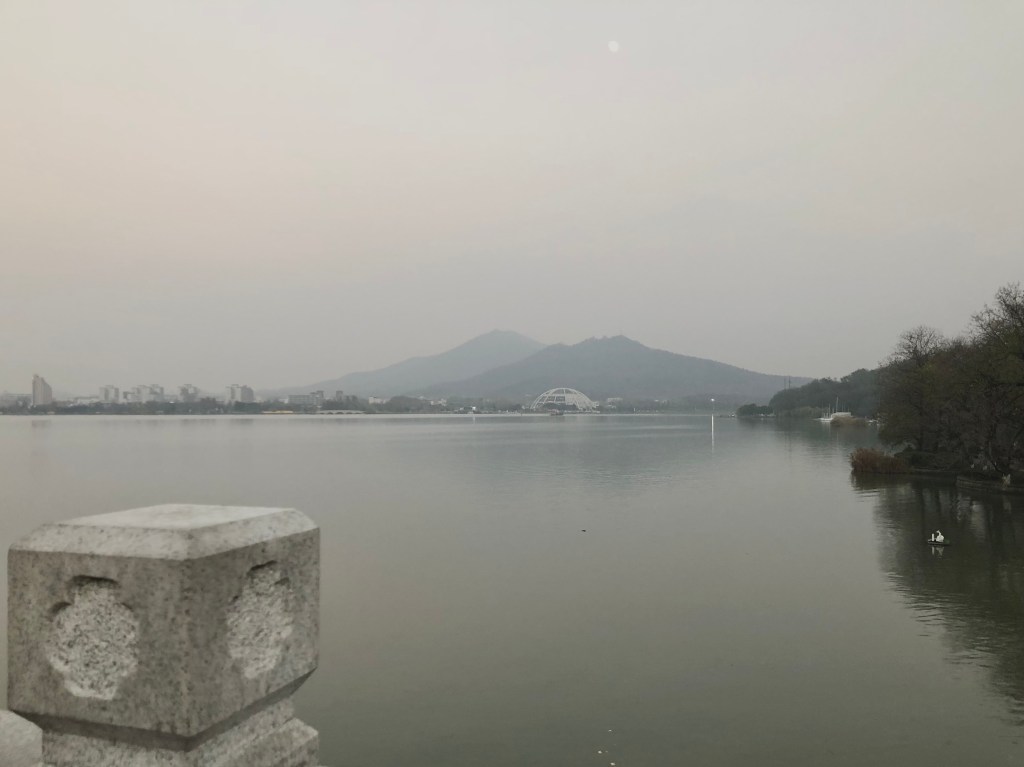
    Nanjing

    Air conditioning blasts throughout the car, fighting a fierce battle against the oppressive heat and humidity outside. As the lush greenery of Xianlin disappears behind me, I arrive at my transfer station. Three minutes until the next train – I’ll need to run. I make it, slipping through the doors with seconds to spare, and take a seat. The train begins hurtling towards the beating heart of the city.

    Students returning home laugh and chat. Tired workers scroll on their phones. An older man boards the train halfway through the trip – I stand up to offer my seat, but he smiles and shakes his head.

    I spend an hour decompressing, listening to Amy Winehouse and the Big Little Lies soundtrack. Halfway through the journey, Spotify stutters. I check my phone – what’s going on? Ah – VPN crash. I reset it, and the music resumes.

    I think of my upcoming trips to Hong Kong and Thailand. Of the long day at work I’ll have tomorrow. Of being thousands of miles away from home.

    The speaker chimes: “鼓楼站,到了。”(Now arriving at Gulou Station.)

    Maybe I’m not that far from home.

    Istanbul

    The third iteration of the adhan, Asr, has just begun. The muezzin’s voice echoes across the city, reverberating across two continents and the gray waters between them.

    Ash-hadu an la ilaha ill-Allah.

    As the devout pray, I board a tram running through the center of the congested streets, struggling to stand amongst the throngs of people in the packed car. A group of fashionable teenagers in leather jackets and Adidas sneakers are on their way to a concert. They jostle for positions as we begin moving.

    Ash-hadu anna Muhammadar-Rasulullah.

    Over the heads of those around me, I watch a chilly breeze toss seagulls around the dark, late-afternoon sky. A solitary ray of sunshine breaks through, illuminating a portion of the twinkling sea beneath it.

    The tram rolls forward as a man beside me mutters Turkish into his phone. The woman across from me clutches her headscarf. I stare out at the sea.

    Somewhere behind the clouds, the sun begins to set. I’m disoriented – is it setting over Asia? Europe? Maybe it doesn’t matter.

    The tram continues moving, as do I.

  • In the Presence of Giants

    In the Presence of Giants

    When I was nine years old, I traveled with my dad to visit an aunt and uncle who live on the Island of Hawaii1. For most people, the words “Hawaiian vacation” connote images of luxurious, White Lotus-like accommodations. But far from staying in an opulent beachfront complex, we pitched a tent in the backyard of their cozy Hilo home.

    Located on the windward side of the island, Hilo is one of the wettest cities in the United States. Suffice to say, while lucky travelers can catch moments of sunshine, it’s generally not the place to visit if you’re hoping for a sunny beach vacation. What Hilo does offer, however, is serenity. Every night of my trip, I would fall asleep to the soft pitter-patter of rain bouncing off our tent’s roof, while geckos chirped their nighttime chorus.

    ‘Akaka Falls, 11 miles north of Hilo. (2024)

    Throughout the two weeks I was in Hawaii, I snorkeled through volcanic tide pools, saw sea turtles basking on black sand beaches, and explored some of the most rugged natural beauty imaginable. I also saw whales. Lots of them.

    Where the Giants Swim

    The warm Hawaiian waters house a cornucopia of marine life, but in winter and spring, they’re home to a special seasonal visitor: humpback whales. These gentle giants embark on annual voyages from their Arctic feeding grounds to the warm, tropical waters of Hawaii to give birth. Fittingly, these journeys have given whales important roles in native Hawaiian culture. Hawaiians call humpbacks and other large whales koholā and have honored them as ʻaumākua – spiritual guardians who can assume the shape of animals, plants, and various natural phenomena.

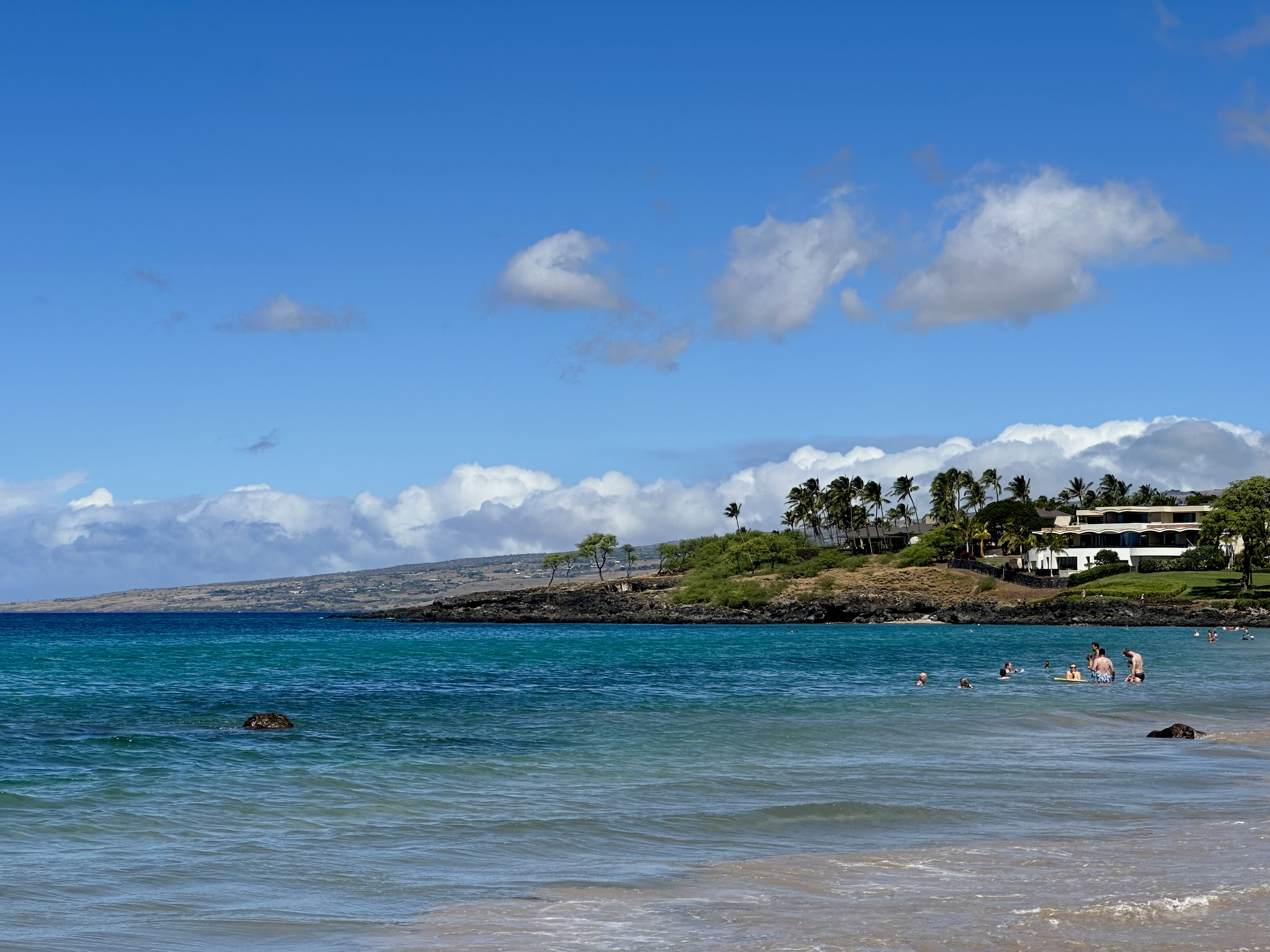
    Hāpuna Beach, a popular destination for swimming, snorkeling, and whale watching. (2024)

    By the time I was nine, I’d already been a whale fanatic for years and hoped to work as a marine biologist when I was older. To my utter joy, I lost count of how many humpbacks I saw within a few days of my trip. I remember driving along the coast and seeing them out in the sparkling blue expanse. At beaches, I would spot their tail flukes and flippers saluting me from a distance. And I even saw several whales breach – propelling their massive, 40-ton bodies out of the water and into the air.

    At the time of my trip, I also had a fascination with the animals of the African savannah, particularly with elephants. But my trip to Hawaii was the first time I came face-to-face with one of Earth’s great leviathans, a being I’d previously only read about. To call it a transformative experience would be an understatement: it opened my eyes to the wonders and diversity of life at a young age. I, a skinny 60-pound kid, saw 50-foot whales in their natural habitat. Today, the trip stands out as one of the first times I recognized the preciousness of life – all life.

    Into the Mist

    Over the following 20 years, I lived a whale-less life, until last summer when I visited the Pacific Northwest to see two friends. Alyssa, a fellow writer and creative who I met in China, has lived in Oregon with her partner Keegan for the past several years, but neither of them had explored much of the state’s stunning coastline. So together, we embarked on a road trip along the coast, regularly stopping to soak up the picture-perfect views. Our main destination, however, was Depoe Bay.

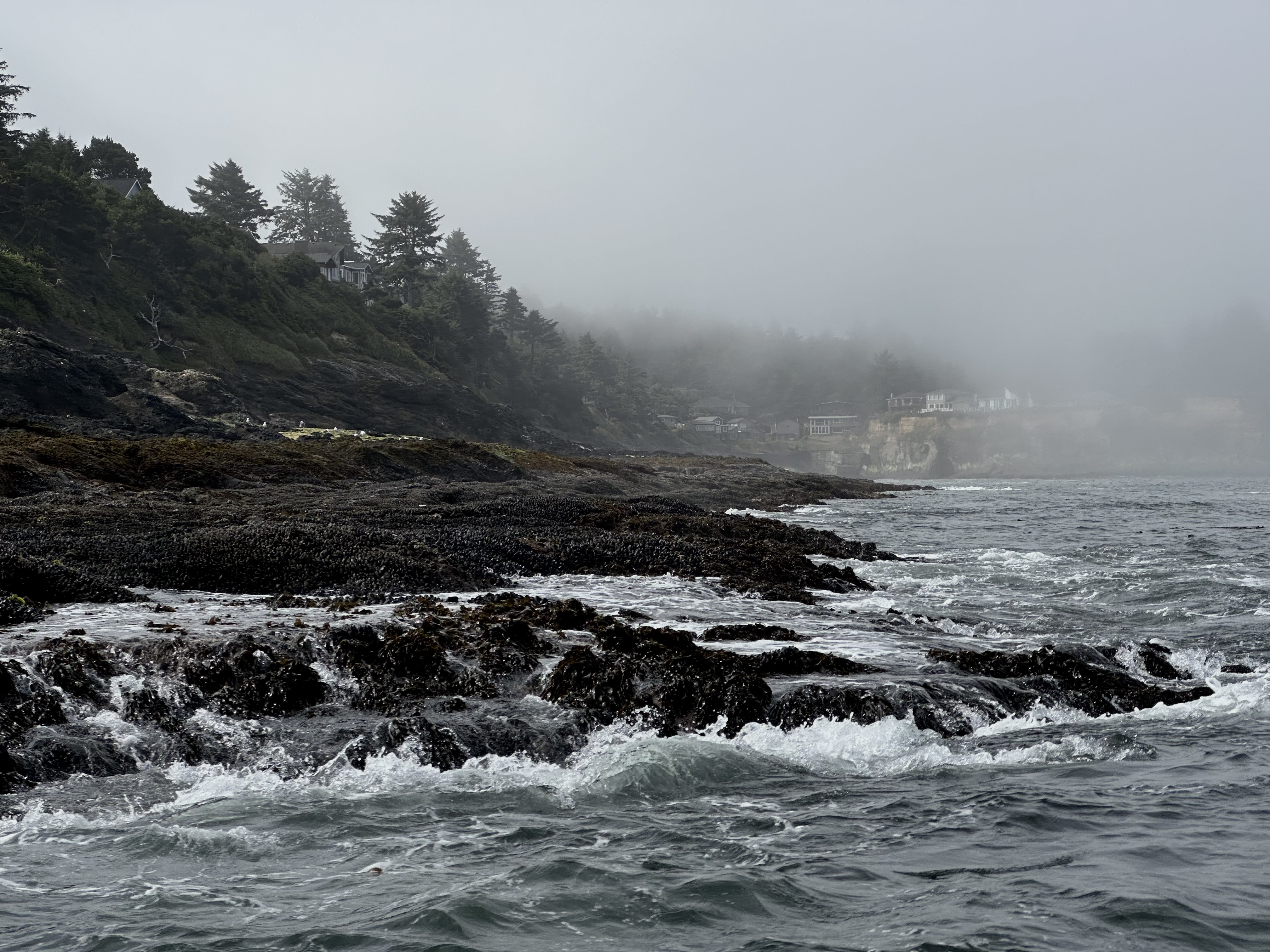
    The rocky, mist-drenched coastline of Depoe Bay. (2024)

    A sleepy town often covered in mist, Depoe Bay looks like something out of Stephenie Meyer’s Twilight novels. But besides housing a collection of quaint shops and restaurants, the town is also home to a renowned museum and whale watching center, Whale Research EcoExcursions. Run by retired marine biologist Carrie Newell, the company specializes in introducing people to the migratory gray whales that pass by Oregon each summer. Throughout her career, Newell discovered key insights about the whales, including the fact that they come to Depoe Bay, specifically, to graze on local shrimp populations. Today, her company offers people the chance to see the gentle filter feeders up close – an opportunity we couldn’t resist signing up for weeks in advance.

    On the morning of our tour, we listened to an orientation on gray whales before boarding a tiny inflatable boat and cruising out of the bay. Visibility is, of course, key when it comes to whale watching, so it was initially disheartening to begin the trip under a dense fog cover. While visual cues aren’t always as obvious as a breach, signs like hovering birds or distant spouts of water can also indicate a nearby whale. But we couldn’t see a thing. Fortunately, around halfway through the trip, another vessel reported spotting a whale, so we quickly rode over to try to find it. For the next half hour, we drifted through the dense fog bank, ears perked for distant splashes or spouts. We floated in silence, the ocean holding its breath along with us.

    Eventually, our patience paid off. A juvenile gray whale named Creamsicle greeted us, emerging from the depths just feet away from our boat. The first appearance was quick, but we watched, entranced, as they surfaced again and again. While they never breached, their size, movement, and presence made the encounter not just memorable, but sacred. Eventually, they disappeared back into the gray expanse, and we made our way back to shore through the salty air. The fog began to lift.

    Creamsicle the gray whale surfacing near our boat. (2024)

    Following the Oregon trip, I had the chance to participate in another whale watching tour, this time in Seattle. While the vessel we travelled on was much larger than the inflatable we’d boarded in Depoe Bay, we still saw orcas, porpoises, and yes – a humpback, as we cruised around the Puget Sound. After the tour, I felt a quiet joy, as though I’d come full circle. I’d gone from being a nine-year-old kid who felt lucky to have seen humpbacks in Hawaii to an adult who had made whale watching into an annual pilgrimage.

    Whale Watching, Responsibly

    I’m still learning about the ecological impact of whale watching, but it’s clear that the noise pollution generated by boats can interfere with the ability of whales and other cetaceans to hunt and communicate. While many modern vessels claim to dampen the noise they generate, not everyone buys it, with some accusing whale watching companies of greenwashing. It seems the most responsible observation, then, is done from shore – ideally with a good pair of binoculars. At a minimum, if you join a whale watching tour, try to partner with a company mindful of its environmental impact, or with one that features tours led by a marine biologist, like Whale Research EcoExcursions.

    Nevertheless, I’d argue that the benefit of seeing these creatures offers intrinsic value, particularly as human action harms them. This past year, I was heartbroken to read that at least 80 migratory gray whales starved to death off the coast of Baja, California, on account of disruptions to their Arctic feeding grounds. The same researchers also observed fewer calves being born, as well as a much higher frequency of emaciated adults. I firmly believe that if more people had the opportunity to observe animals in their natural habitats, understood the essential ecological role every species plays, and recognized how climate change harms them, collective movements would unite to end this madness. (As always, it’s worth pointing out that stopping the destruction of the biosphere is already technologically feasible – what’s lacking is political power.)

    Although the nine-year-old whale fanatic in me hates reading about gray whale starvation, the realist in me understands that doing so is essential. You can’t stop something you don’t care about, nor can you end something you don’t understand. In the years ahead, we’ll all need to channel both our inner child and our realist adult to foster meaningful change.

    A Candle in the Dark

    When I’m feeling nihilistic, it helps to remind myself of the wonders we share the planet with. Humpback whales that sing ethereal songs in the cerulean depths. Orca pods that have distinct cultures. Gray whales, like Creamsicle, that embark on 10,000-mile migrations across the sea. It’s hard not to be blown away seeing these animals in the wild, because even from a distance, their intelligence shines like a beacon. I believe the world would be a gentler place if more people went whale watching, but beauty is everywhere – and not limited to marine mammals – if you know how to look.

    Earlier this year, my partner and I decided to spruce up our garden. While we couldn’t bring the tropical coral reefs of Hawaii to Atlanta, we did add zinnias, sunflowers, and several other plants to our small backyard. We now share the space with pollinators. Lots of them.

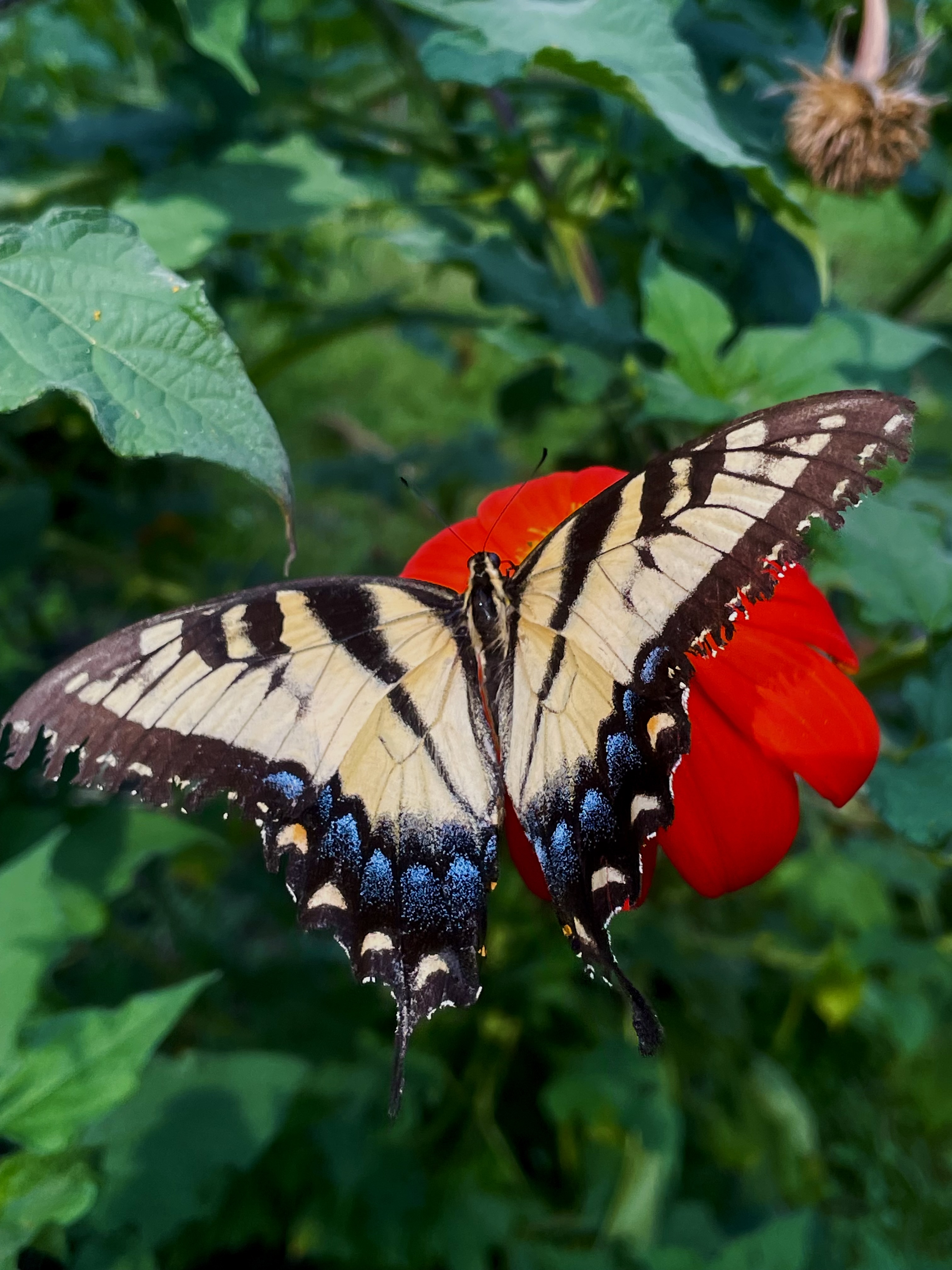
    Fluttering hummingbirds now zip from bloom to bloom, fuzzy bumblebees somersault through bushes, and majestic butterflies spend entire afternoons probing for nectar. The world might often feel overwhelming, but I can still stand at my window and observe an entire playground of nature. So these days, I put my ear to the ground, listening for where I can make the most meaningful impact, while appreciating the other forms of life that are my neighbors. And, of course, by taking advantage of every opportunity that lets me see more whales.

    An eastern tiger swallowtail in my backyard. (2025)

    If you’re also feeling overwhelmed at this moment, look for whales. Plant flowers. And understand that this world is still worth fighting for.

    While I have many role models, I find myself increasingly turning to the wisdom of Carl Sagan. From showcasing the wonders of the universe in Cosmos to providing us with eerily prescient warnings in The Demon-Haunted World: Science as a Candle in the Dark, his words will always be both comforting and enlightening.

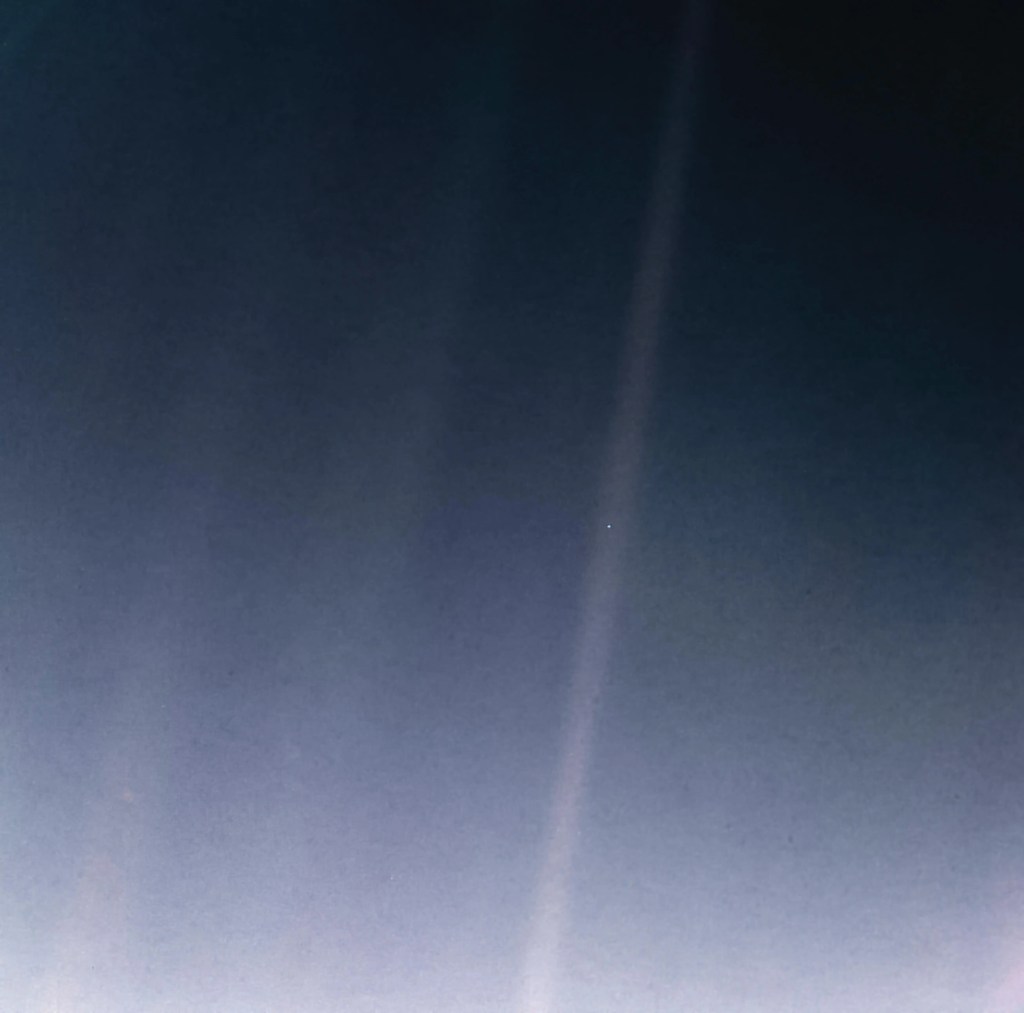
    He says it best in Pale Blue Dot:

    Look again at that dot. That’s here. That’s home. That’s us.

    On it everyone you love, everyone you know, everyone you ever heard of, every human being who ever was, lived out their lives.

    The Earth is a very small stage in a vast cosmic arena. Think of the rivers of blood spilled by all those generals and emperors so that, in glory and triumph, they could become the momentary masters of a fraction of a dot. Think of the endless cruelties visited by the inhabitants of one corner of this pixel on the scarcely distinguishable inhabitants of some other corner, how frequent their misunderstandings, how fervent their hatreds.

    Our posturings, our imagined self-importance, the delusion that we have some privileged position in the Universe, are challenged by this point of pale light. Our planet is a lonely speck in the great enveloping cosmic dark. In our obscurity, in all this vastness, there is no hint that help will come from elsewhere to save us from ourselves.

    The Earth is the only world known so far to harbor life. There is nowhere else, at least in the near future, to which our species could migrate. Like it or not, for the moment the Earth is where we make our stand.

    It has been said that astronomy is a humbling and character-building experience. There is perhaps no better demonstration of the folly of human conceits than this distant image of our tiny world. To me, it underscores our responsibility to deal more kindly with one another, and to preserve and cherish the pale blue dot, the only home we’ve ever known.

    A photo of Earth taken by Voyager 1 in 1990, 3.7 billion miles from the Sun. (NASA)

    1: In this essay, anglicized spellings such as “Hawaii” are used due to font limitations. In proper Hawaiian, these words include the ʻokina (ʻ) and kahakō (macron), which reflect the language’s pronunciation and meaning more accurately — e.g., “Hawai‘i” and “ʻaumākua.”