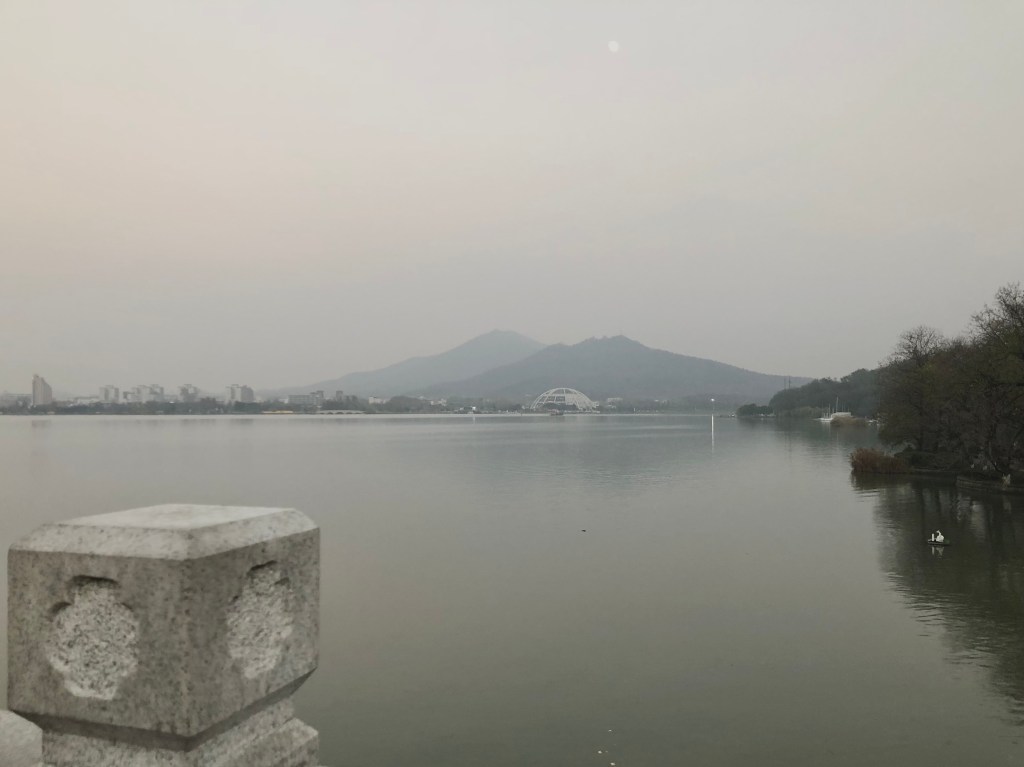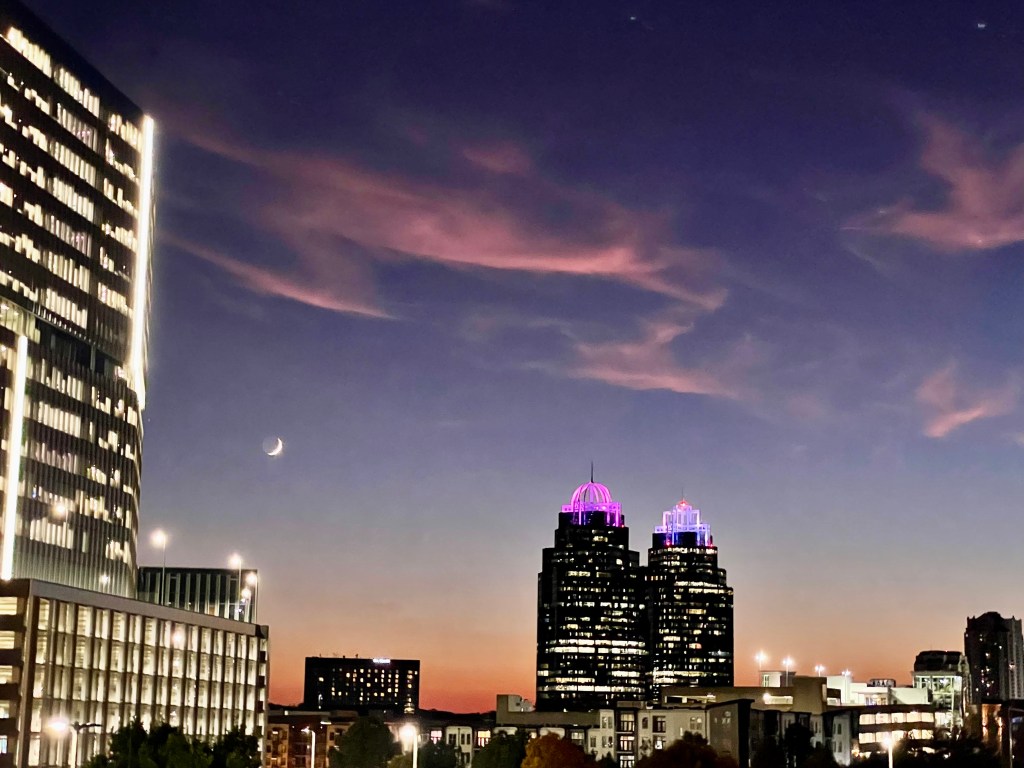
Author: Chandler Webster

  • Atlantans Voted for Safer Streets. Where Are They?

    Atlantans Voted for Safer Streets. Where Are They?

    I’ve lived in Atlanta for five years, as of writing this.

    Two of those years were spent in Midtown, an affluent neighborhood just north of Atlanta’s downtown. Every city has such a place—luxury apartments with balconies and dog parks dot the horizon; trendy restaurants fill up for happy hour, serving spicy margaritas alongside overpriced appetizers; and Lululemon-clad locals work from home while sipping flat whites and sporting healthy credit scores. An environment that can become grating, after prolonged exposure.

    That’s exactly what happened, when our third year in Atlanta became imminent, so my partner and I decided to relocate to a single-family home in Lindridge-Martin Manor (LMM), a suburban neighborhood north of Midtown.

    The transition was difficult but rewarding: suddenly, we had a yard, a guest bedroom, and numerous windows from which our cat could stalk wildlife. Our new surroundings were a far cry from the urban density we had grown used to, but it was easy to look past the picket fences and hydrangeas around us, as LMM’s central location kept us close to Midtown, Buckhead, and Buford Highway. And, as a public transportation enthusiast, I comforted myself with the knowledge that the closest MARTA station was only a mile away.

    We felt like we had made it.

    As the months passed, our love for our new home grew, but we began to notice the limitations of our surroundings. We realized that we had moved from one of Atlanta’s only bastions of urbanism into an environment representative of the metropolitan area as a whole—a neighborhood where the needs of drivers are prioritized at the expense of others. And while we could attempt to ignore this car-centric reality, adamantly walking or biking from place to place, doing so made for an unpleasant experience, at best, and an outright dangerous one, at worst.
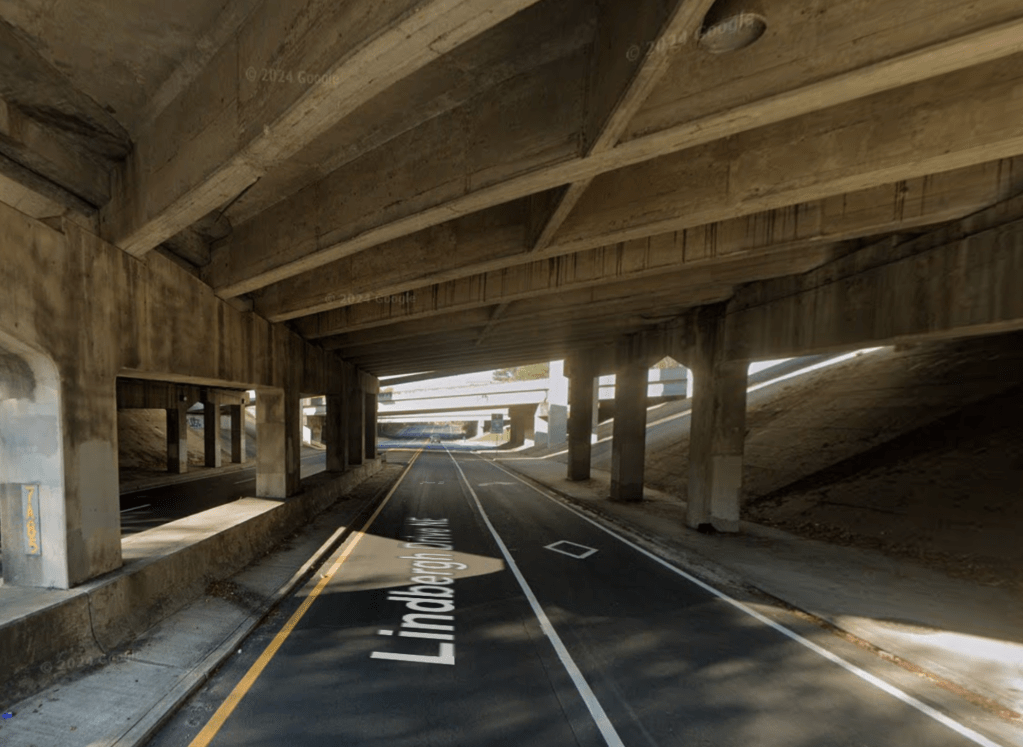
    The charming underside of the I-85.

    From the Lindbergh Center MARTA station to the string of (surprisingly impressive) Cheshire-Bridge restaurants, I’ve tried walking to many destinations and have realized that doing so, even if somewhere appears close, requires an odyssey. Whether that entails passing under the twelve lanes of the I-85, sprinting across six lanes of rush hour traffic, or simply walking down a narrow sidewalk as oblivious drivers fly by depends on the day. A lack of regard for those outside of vehicles persists, regardless.

    This past May 18, these conditions led to tragedy when a driver heading down Lindbergh Dr. NE struck and killed a pedestrian. While the investigation remains ongoing, it appears they drove their vehicle over the curb, where the victim was waiting at a bus stop. The unnamed individual died at the scene, their life taken and their story lost within the noisy, smog-filled chaos that is Atlanta traffic.
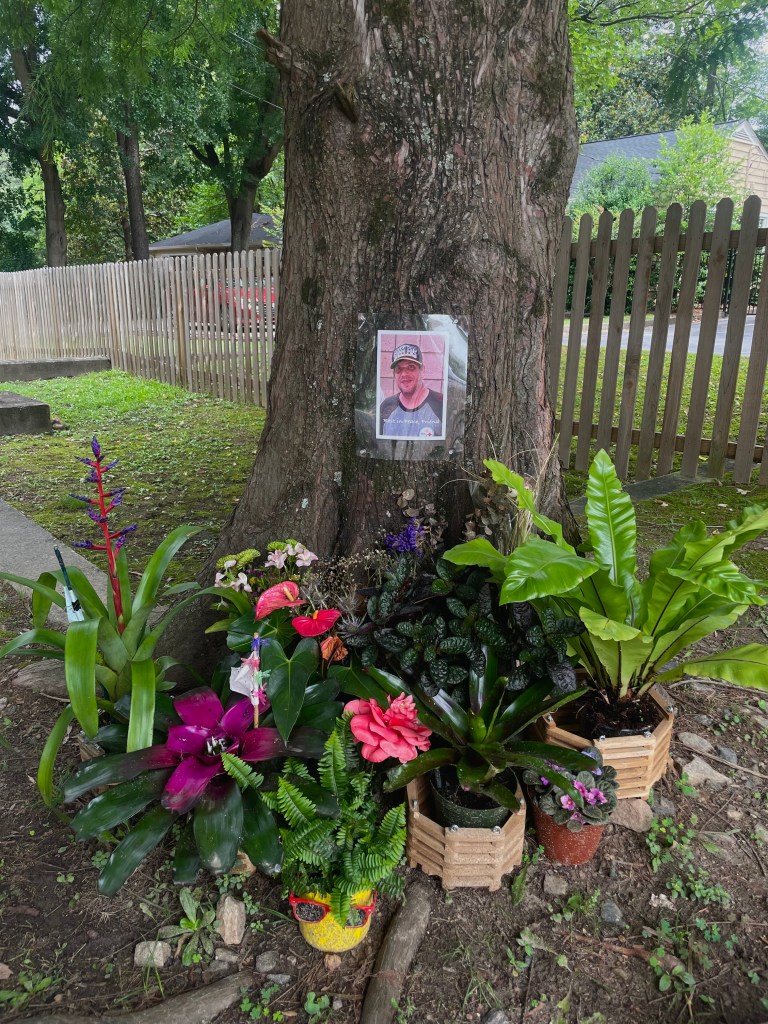
    A pop-up memorial for the LMM victim. The photo reads “Rest in Peace, Friend.”

    “Pedestrian fatally struck by car in NE Atlanta.”

    “Pedestrian struck by vehicle in Lindbergh area of Atlanta.”

    “Pedestrian traffic fatality.”

    News outlets often use detached language when reporting traffic crashes, as if automobile-induced violence were merely an unavoidable aspect of modern life. But as Sarah Goodyear and Doug Gordon highlight in their book Life After Cars, each “fatality” creates a ripple of trauma that can circulate through entire communities.

    We don’t know who was killed on May 18, but the pop-up vigil that appeared at the site tells us they were loved. They likely had family, friends, and coworkers in their life whose hearts now ache, and who continue to process their grief.

    But as tragic as this incident was, it’s far from an isolated incident.

    In the early 2020s, when much of the world was mask-clad and social distancing, communities around the United States saw a marked increase in traffic fatalities. Across the five counties that comprise the Atlanta Metro, crashes killed a staggering 520 people in 2021 and 496 people in 2022. In the years since, fatalities have trended downward, but they remain higher than pre-pandemic levels.

    While the exact cause of this spike in traffic violence is unclear, many attribute it to fewer vehicles on roads, enabling those that remained to travel at higher speeds. While dangerous for those buckled into motorized steel cages, higher speeds are deadly to pedestrians and bicyclists, who have no seatbelts, airbags, or other protections. Notably, cars don’t need to move at racecar-level speeds to cause tragedy—a vehicle moving at around 30 mph has a 50 percent chance of causing severe injury to a pedestrian and a 25 percent chance of killing them. At higher speeds, the risk of bodily harm increases exponentially.

    Over the past few decades, America’s obsession with super-sized cars and trucks has exacerbated these risks. Since 1980, vehicles have bulked by an average of 1,000 pounds, while growing 12 percent longer and 17 percent wider in the past decade. Indeed, although most crashes in Atlanta are vehicle-to-vehicle, pedestrians are overrepresented in fatalities, comprising an average of 35% of all deaths in the past five years. This includes the LMM crash, where the driver was behind the wheel of a Ford F-150—a truck that exemplifies the trend of gargantuanism. 

    Larger vehicles also feature limited fields of vision. Graphic courtesy of the City of Portland, Oregon.

    It’s difficult to say what could have made a difference on May 18, as the exact circumstances that led to the crash remain unclear. But a better protected bus stop, a wider sidewalk, and a pedestrian crossing sign to remind drivers that people live and walk here couldn’t have hurt. None of these upgrades are expensive or unrealistic—on the contrary, Atlanta’s Vision Zero Action Plan cites them all as “Recommended Systemic Safety Counter Measures.” This comprehensive roadmap seeks to not only reduce, but eliminate fatal and severe crashes by 2040. 

    Unfortunately, while ambitious, local advocacy groups have expressed concern over the city’s progress towards its Vision Zero commitments. One such group is Propel ATL.

    Founded in 1991 as the Atlanta Bicycle Coalition, the ABC merged with Pedestrians Educating Drivers on Safety (PEDS) in 2021, rebranding as Propel ATL in 2022. Today, the organization aims to grow Atlanta’s streets into “safe, inclusive, and thriving spaces for people to walk, ride, and roll.” 

    Following the crash, I reached out to Propel ATL to discuss it within the context of larger, city-wide trends. They agreed to meet, but before speaking, made me aware of another crash that had recently occurred in Atlanta’s West End. Again, near a bus stop. 

    Terence Cobbs, known by those close to him as “Yohan,” had occupied a bench near the corner of Ralph David Abernathy Boulevard SW and Joseph E. Lowery Boulevard SW for years. Well-known by many in the community, he was 40 years old on May 12, when a driver struck him while he was on the sidewalk. He died at Grady Memorial Hospital shortly after.

    Two pedestrians killed, both near bus stops. What did this mean?

    A family-submitted photo of Terence Cobbs.

    On June 8, I met with Propel ATL’s Executive Director Rebecca Serna. With a background in Urban Policy and Fulbright experience studying participatory planning practices and innovative public transportation projects in Colombia, Rebecca and her team are experts at tracking Atlanta’s progress towards building safer streets. When progress is slow or non-existent, that means holding elected officials accountable and advocating for more. 

    “Drivers need to feel uncertain,” Rebecca said, when I asked her about deterrents to reckless driving. “When they do, they tend to slow down. Narrower lanes, trees along roadways, safe crossing signs… all are visual cues that remind them to drive slower and look for pedestrians.”

    On the stretch of Lindbergh Dr. NE where the pedestrian was killed, no form of traffic calming infrastructure is present, and one side of the street doesn’t even have a sidewalk. This contrasts with the western portion of the two-mile-long street, which has sidewalks, pedestrian crossing signs, and chicanes (artificial obstacles that force drivers to slow down).
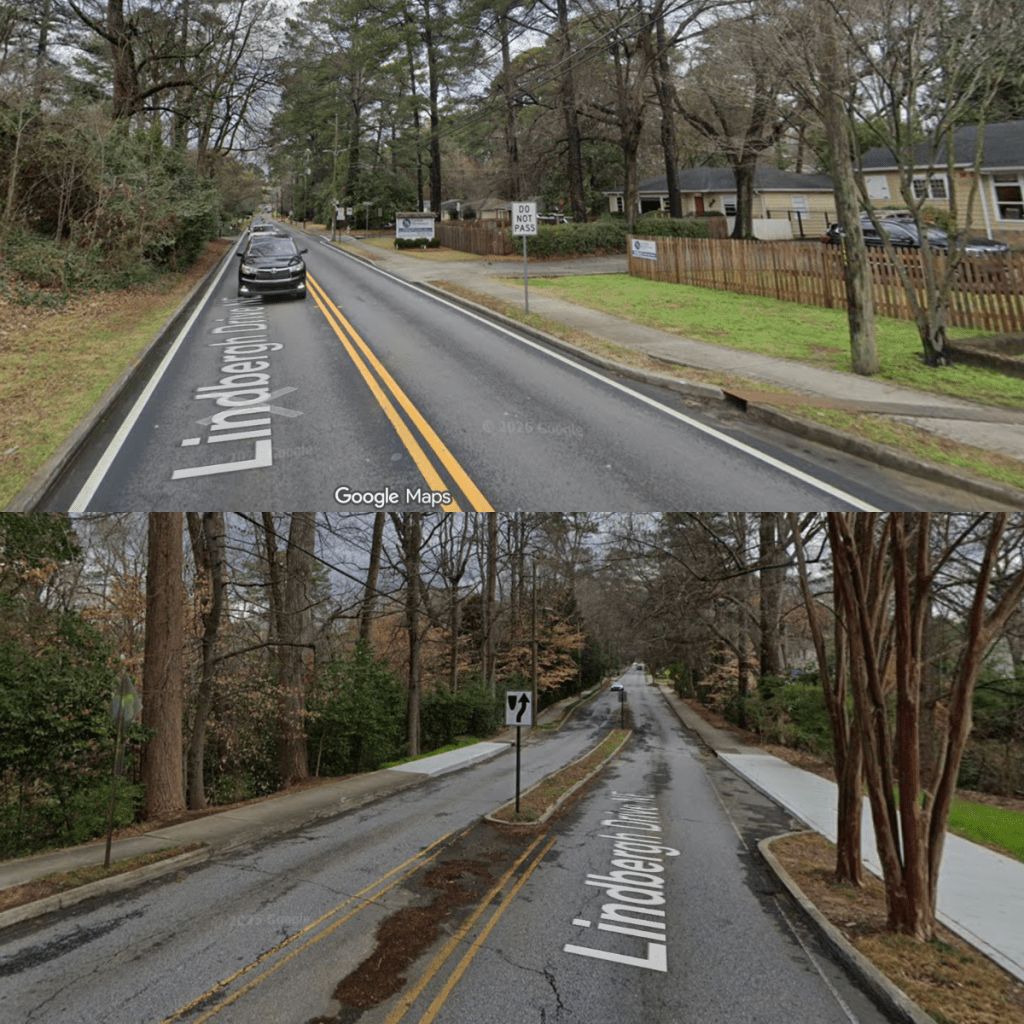
    The approximate location of where the LMM victim was killed (top), compared to the street’s western side (bottom), where traffic calming solutions are present.

    Creating friction for drivers is always a good idea, but this is especially true near bus stops. As the deaths of the LMM victim and Terence Cobbs highlight, many pedestrian deaths occur within walking distance of bus stops—59 percent, according to Propel ATL’s own research. To that end, potholes—despite being the bane of drivers everywhere—can sometimes be useful.

    “Potholes are a natural traffic calming solution, and too often, they’re the only form of traffic calming we have,” Rebecca said.

    Our goal, of course, shouldn’t be to let streets deteriorate into pothole-ridden messes, but to use their inevitable repavings as opportunities to advocate for better infrastructure, especially because so many people reach out to city officials to complain about them. 

    As our discussion shifted to city-wide trends, I asked Rebecca whether she felt Atlanta was on track to meet its 2040 goal of zero traffic fatalities. 

    “No, I do not,” she said without hesitation. “Vision Zero is a great plan—a lot of people have put a lot of work into it. And yet the city’s current draft budget intends to cut Department of Transportation funding.”

    Since we met, the city formally approved its fiscal year 2027 budget. The Department of Transportation lost $2.2 million in funding, a reduction of nearly 4 percent, while Parks & Recreation, City Planning, and other departments saw similar cuts. Funding for police, however, grew by $16.5 million—at $324 million, it now comprises nearly 33 percent of the city’s total budget. This, despite the fact that traffic crashes killed more people than homicides in 2024. 
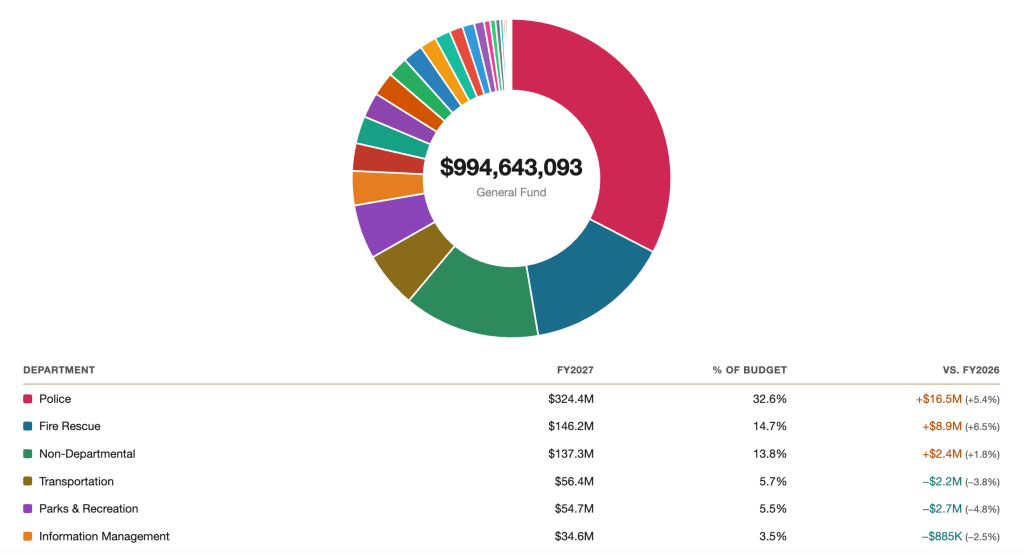
    Graphic courtesy of the Center for Civic Innovation.

    But this reactive approach to public safety isn’t new in Atlanta. Nor, as the past few years have shown, is it popular.

    In 2021, officials announced plans to build the Atlanta Public Safety Training Center on an 85-acre site south of the city. From its conception, the project—infamously nicknamed “Cop City”—drew criticism: only 48 percent of Atlantans supported the facility, while 52 percent were unsure or against it. As resistance efforts grew and culminated in occupied protests, George State Patrol Troopers shot and killed activist Manuel Esteban Paez Terán (Tortuguita) and arrested dozens of others. Following these events, over 100,000 Atlantans called for a referendum, but City Council members dismissed these demands as legally moot. The facility opened in April 2025.

    This controversy stands in stark contrast to safer streets and public transit expansion—both of which Atlantans have expressed clear support for. 

    In 2016, 71% of voters supported funding MARTA expansion through a sales tax, and in 2022, another overwhelming majority voted to fund safer streets through Moving Atlanta Forward. But unlike Cop City or a ballooning police budget, progress towards these endeavors is hard to find: MARTA expansion has been slow or non-existent, and many of the city’s Moving Atlanta Forward projects have stalled. This quagmire has eroded the public’s confidence in elected officials’ ability to deliver, leading many Atlantans to believe that meaningful public transportation expansion will never happen. 

    While hardly a place for measured discourse, Reddit posts nevertheless epitomize these feelings of disappointment. “More MARTA was established in 2016. Ten years and zero projects,” comments one user, in response to a recent MARTA story shared on r/Atlanta. “I genuinely think we need to start arresting people at MARTA and at the city of Atlanta over how taxpayer funds are mismanaged,” suggests another, while receiving 246 upvotes.
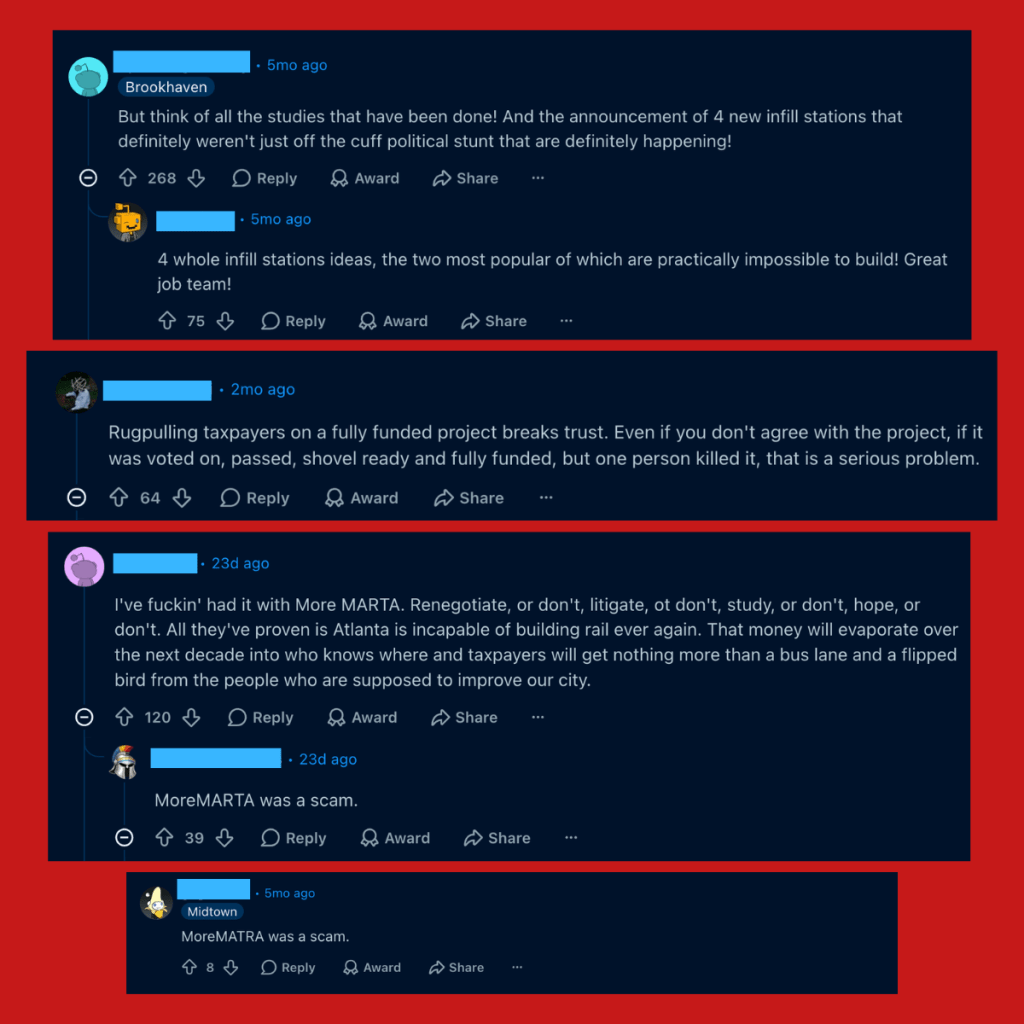
    Some (of many) comments pulled from r/Atlanta and r/MARTA.

    I asked Rebecca where she believes this disconnect in public sentiment and elected official response stems from.

    “Such a big question,” she laughed. “Something that concerns me with MARTA, specifically, is the revolving door between consulting agencies and their top leadership. If you look at what MARTA spends on planning versus what’s actually being built, there’s a huge disconnect. Both MARTA and the City of Atlanta, as a whole, struggle with project delivery.”

    But she also emphasized how 2019, the year the city formed its own Department of Transportation, offered a breath of fresh air.

    “Previously, getting things done was even more difficult, as the city’s answer to everything was: we’ll use consultants. That was a really bad answer, and we pointed it out, which is part of what led [the city] to getting a Department of Transportation.”

    The key, now, is to hold elected officials accountable to their commitments, particularly as several high-profile incidents risk turning people against MARTA.

    I asked Rebecca what that pressure could look like.

    “We started a campaign called Where’s My Project?, and it tracks the progress towards the projects taxpayers voted for through Moving Atlanta Forward. I would encourage people to get involved in that campaign, as it’s grassroots and helps bring people together to organize,” Rebecca said.

    If that feels daunting, there’s an even simpler thing to do.

    “Just send an email to your city council member saying how important safer streets are to you,” Rebecca said. “You don’t have to be an expert, you just have to know the outcome you want. Elected officials—particularly the mayor—don’t often hear from people with these concerns.”

    To that end, I reached out to Councilmember Alex Wan, who represents Lindridge-Martin Manor, and the Atlanta Department of Transportation for comment—both as a journalist and a concerned citizen. Neither party responded to my inquiries; presumably, they were lost within a sea of pothole complaints and other similar grievances. 

    More noise is needed.

    ***

    I recently left my house and saw a new addition to the nearby 35 mph speed limit sign: a Dynamic Speed Monitoring Display (as it’s officially known) that uses radar to tell drivers how fast they’re moving. While I’m skeptical of this tool’s ability to calm traffic, I see it as a step in the right direction. More importantly, I’m hopeful that it’s just one of many planned upgrades to the street.

    We can’t bring back the Lindridge-Martin Manor victim, Terence Cobbs, or any of the other pedestrians, cyclists, or drivers killed while navigating Atlanta’s streets. But we can honor their legacy by amplifying their stories and pressuring elected officials into delivering on their commitments. 

    Traffic violence is not a given, nor should it be normalized—other countries, and even other American cities, have shown that it’s possible to reduce car dependency, build safer streets, and meaningfully expand public transportation.

    It’s time for Atlanta to do the same.
  • Salmon, Sweetgrass, and Reciprocity in the Age of Exploitation

    Salmon, Sweetgrass, and Reciprocity in the Age of Exploitation

    There’s a place on Earth where trees grow tall as towers, their branches caressing the sky like fingers. 

    Beneath this verdant canopy, ocean fog drifts between trunks, saturating everything in a cool, dreamlike glaze. Moss is ubiquitous, covering trunks and boulders the size of cars in velvet green coats, while ferns blanket the ground, sheltering beneath the shade of the giants around them. Within this rich ecosystem, animals are as abundant as plants. Mother bears with cubs lumber around looking for food. Otters paddle and twirl through mountain rivers. And salmon—colorful and essential to this region’s wellbeing—splash hundreds of miles upstream to spawn.

    Oregon Rainforest
    An Oregon rainforest. (Thomas Shahan, Flickr)

    Salmon are a keystone species in the lush landscapes of the Pacific Northwest. While most aquatic animals live in saltwater or freshwater environments, salmon can survive in both. Every year, they travel from their ocean homes to streams, rivers, and lakes to lay eggs, passing through estuaries along the way. Salmon depend on these brackish halfway points; within them, their bodies undergo physiological changes that prepare them for their freshwater forays.

    As the migrating salmon move inland, bears, eagles, and humans feast on them, leaving their fishy carcasses within the dense undergrowth after eating their fill. Over time, the volume of briny, decomposing bodies introduces substantial amounts of nitrogen to these freshwater ecosystems, thus nourishing not only predators, but plants, too.

    Sammamish kokanee
    A Kokanee salmon in the Lake Sammamish watershed. (USFWS – Pacific Region, Flickr)

    The salmon that make it to the spawning grounds lay thousands of eggs, only to die shortly after in a final act of poetic significance—their life’s purpose now complete.

    Anthropic Narcissism 

    While salmon are crucially important to the environment, their population has plummeted in recent centuries. 

    As settlers replaced Indigenous peoples, harvest goals shifted from sustenance to profit, with little regard for population integrity. Grazing space became another priority, since settlers also brought herds of cattle with them. Thus, estuaries—some of the most productive ecosystems on the planet—became obstacles, and people got to work dredging, damming, and otherwise eliminating them. Without these vital pathways and rest stops, salmon could no longer migrate, nor feed anyone.

    Scientists estimate that in the past, between sixteen to twenty million salmon migrated inland across the Pacific Northwest each year; now, that number is around one million.

    Once the ecological role of salmon and was understood, conservation efforts like the Endangered Species Act were implemented. Today, the ESA protects twenty-eight Evolutionary Significant Units of Pacific Northwest salmon and steelhead, providing support for recovery plans, hatchery programs, and habitat restoration efforts.

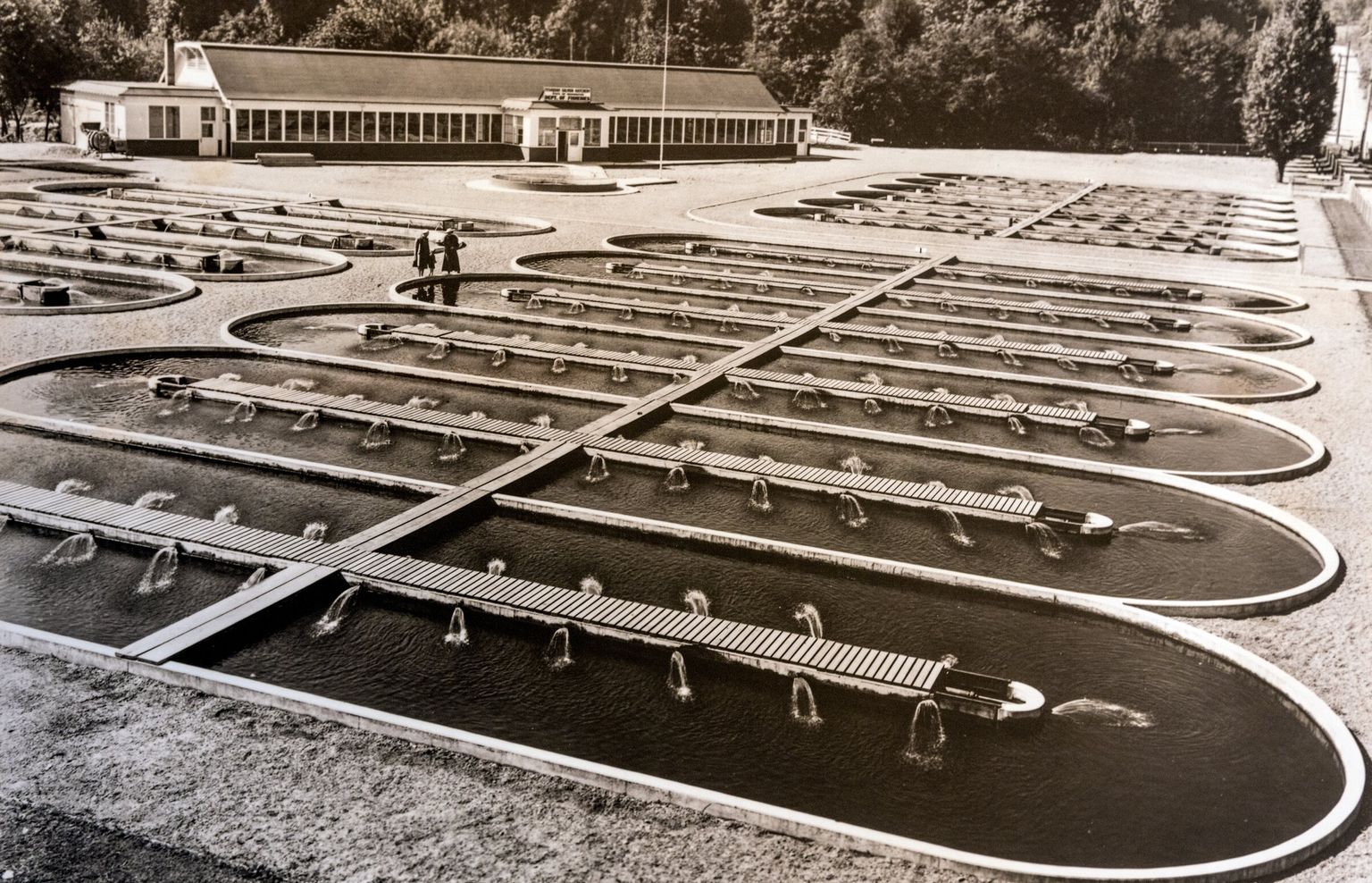
    The Issaquah Salmon Hatchery, 1936. (The Seattle Times)

    Unfortunately, both Trump administrations have been not just unfriendly to salmon (and myriad other endangered species), but outright hostile. From abandoning climate pledges to rolling back protections on clean air and water, officials are wrecking the planet with a degree of tenacity only possible thanks to their incessant misinformation campaigns. The ESA, in particular, has sustained repeated attacks, opening the door to renewed habitat destruction and population endangerment. While a federal court struck down the Administration’s most recent assault on the ESA, subsequent attacks will doubtlessly follow, and their repercussions will extend far beyond salmon.

    From monarch butterflies to California spotted owls and Florida panthers, the anthropic narcissism that defines our times impacts all threatened and endangered species, as well as the countless others that depend on them.

    Rage and Gratitude

    When reading these sorts of stories, itʻs hard not to feel rage.

    Rage at the hubris of the rich, content to sleep in beds of money while they destroy the planet. At the arrogance of settlers, who thought they understood lands better than the Indigenous peoples who’d resided on them for millennia. And rage at ourselves—at each of us, in our way—for our complicity in ecocide.

    But while we should feel rage over salmon deaths, over gray whale starvation and golf courses, over the pollution of sacred lakes and rivers and so much more, anger isn’t enough. We need something more powerful than rage—a paradigm shift in our collective thinking that can help us reharmonize with the natural world. For help, it’s worth turning to the work of botanist and author Robin Wall Kimmerer.

    In her book Braiding Sweetgrass, Kimmerer introduces numerous plants, highlighting their ecological benefits alongside their roles in Native cultures. But she also argues that seeing plants solely as oxygen-producing climate regulators hampers our ability to fully appreciate them. While grasses, shrubs, trees, mosses, and non-vascular varieties, such as fungi and lichens, are essential to the environment, they’re also complex organisms deserving of our respect.

    Kimmerer leading a class in upstate New York. (SUNY College of Environmental Science and Forestry)

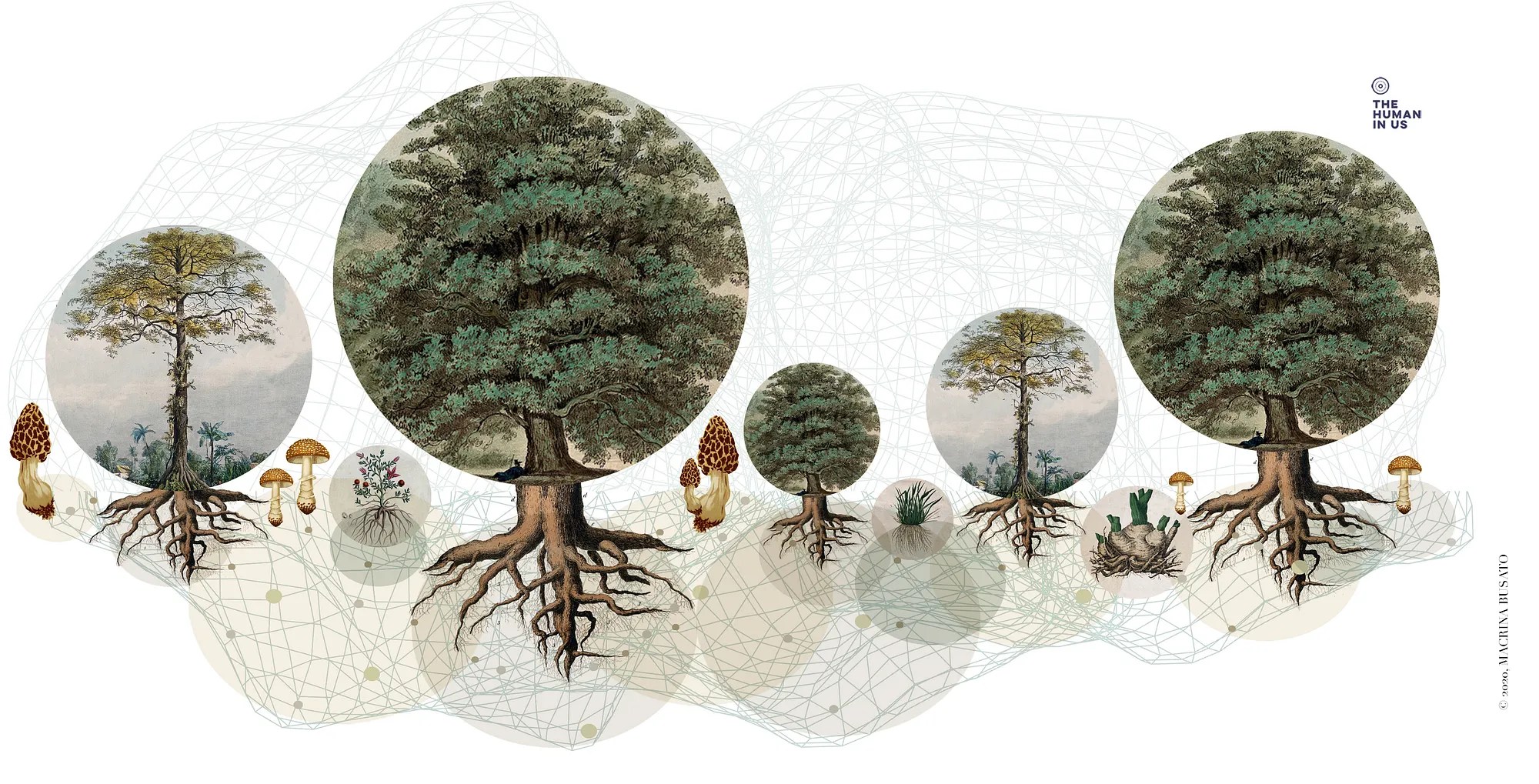
    Fruit trees, to take an example from the book, communicate with one another via pheromones, debating when to produce fruit and then doing so, collectively, once consensus is reached. Besides overwhelming would-be-fruit-eaters, this release of airborne volatile organic chemicals (VOCs) allows for the discussion of other matters, such as pest invasions and when nearby trees should activate their defense systems. Meanwhile, beneath the earth, mycorrhizal fungi networks connect root systems, allowing trees to send direct signals about diseases, droughts, and other threats. By using this underground web, established trees can even share nutrients like carbon, helping others—particularly younger saplings—grow strong.

    From cedar trees in the Pacific Northwest to the mangroves of the Everglades, the trees around us aren’t isolated organisms—they’re part of a vast, interdependent network of shared abundance.

    An illustration of the “internet of trees.” (Macrina Busato)

    Then there are agricultural plants, which humanity has depended on for sustenance for twelve thousand years. Today, corn, rice, wheat, and similar plants cover one-tenth of the earth, supplying the staples that stock grocery store shelves around the world. Coated in plastic and disposed of, if they don’t sell, our global supply system makes it easy to take the food we eat for granted, while having us believe that we’ve domesticated this critically important group of species. But as we’ve propagated, irrigated, fertilized, weeded, and pruned on their behalf for millennia, it may be more apt to say that they’ve domesticated us. 

    And lichens, some of the simplest forms of life, in many ways, aren’t one organism, but two. Each lichen is comprised of a fungus and an alga—two beings that work alongside each other for survival. As the fungus “farms” the sugars produced by the alga, some scientists say that fungi were the first organisms to invent agriculture.

    Notably, efforts to recreate lichen in stable laboratory conditions are generally unsuccessful. Only when conditions become severe do the alga and fungus unite, individualism switching to reciprocity.

    Studying and observing the natural world allows us to deepen our appreciation for it, growing our relationship from textbook-level to gratitude. As Kimmerer explains, gratitude is essential because you don’t want to harm something you care about: You want to protect it.

    Collective Reciprocity

    Like the estuaries that salmon pass through, gratitude is a stop along the way to our final destination: reciprocity.

    This framework—of recognizing the bounty the natural world provides and showering it with gifts, in return—is another core theme of Kimmerer’s work. But reciprocity comes with a set of obligations, both on the individual and collective levels. 

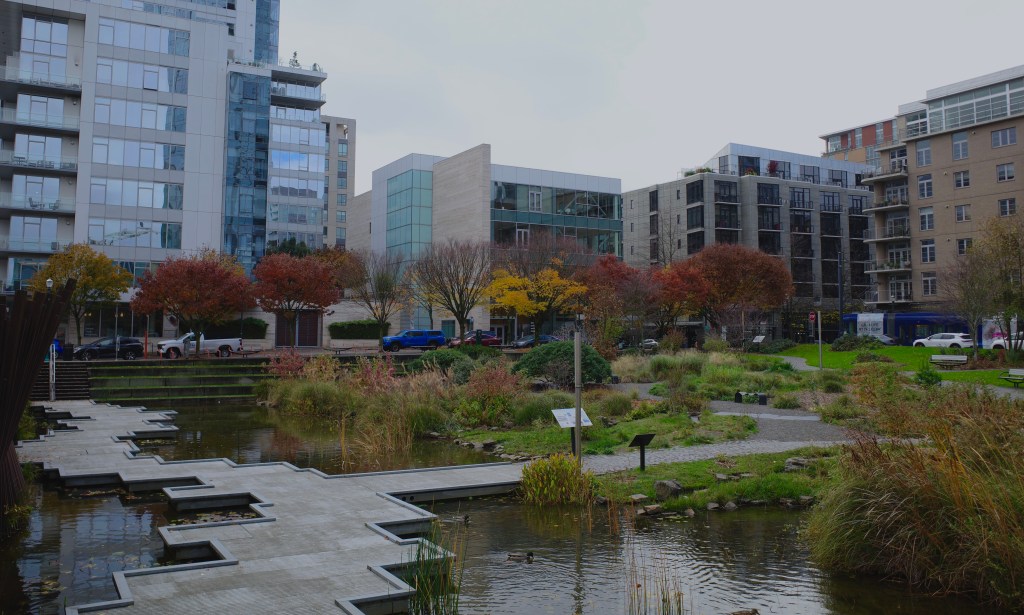
    Collective reciprocity at work. Tanner Springs Park, a native oak-prairie wetland in Portland, Oregon. (2025)

    As an individual, reciprocity means using the tools and resources at your disposal to give back. If you’re a writer, that might mean using your voice to shed light on topics ranging from ecological issues to enshittification. If you’re an educator, it may involve fostering the innate care and compassion of your students. And if you’re a member of the working class, trying desperately to make ends meet while being one paycheck away from disaster, reciprocity can be as simple as recognition: acknowledging what nature provides and giving thanks to it, in return. 

    But individual actions, while meaningful, aren’t enough.

    Collectively, we’ve chosen to distance ourselves from reciprocity, choosing instead to embrace its ugly opposite: exploitation. Modern business schools teach students that our planet offers a bounty, yes—but one that translates to infinite economic growth. Corporations are not just permitted, but expected to rake in profits while laying waste to the planet. And our politicians care little for fish, plants, or constituents, focusing their attention, instead, on lobbyists and their reelections. As a species, we’ve tacked price tags onto everything, and the commons exist—be they forests, foreign fossil fuels, or whales—for extraction. 

    The Tragedy of the Commons: Deforestation in the Amazon. (AFP via Getty Images)

    Thus, returning to a place of gratitude and reciprocity begins with us viewing the world with less arrogance. Human ingenuity is remarkable, but we can’t allow it to morph into hubris, especially when thereʻs so much to learn from those around us.

    We may see fish as simple, but migratory species like salmon highlight the value of long-term, multi-generational thinking: After journeying for hundreds of miles, they trade their lives so that the next generation can survive. Trees might not have larynxes, but they communicate nonetheless, demonstrating how those who thrive have an obligation to help others (including other species) do the same. And lichens show us that when conditions worsen, cooperating with one another isn’t optional, but necessary.

    Of course, nature can appear cruel, and at times, cutthroat. But intense competition is usually a feature of young, developing ecosystems—not established ones with layers of checks and balances. A forest perennially at war with itself couldn’t survive; thus, scarcity and hoarding aren’t features of mature ecosystems.

    Abundance, on the other hand, is. 

    An old-growth forest in the Pacific Northwest. (U.S. Fish and Wildlife Service)

    A cutthroat economic system that devours and hoards is similarly unsustainable—for humans and the planet. Like a young forest, we should see the exploitation and competition of our times as features to shed on our path to maturity.

    Fighting for Abundance

    Alarm bells should be ringing. 

    Instead of fighting to preserve the climate and protect the species we cohabitate with, our government is driving us ever closer to the precipice. As we careen towards the edge, the effects of this recklessness are becoming increasingly apparent.

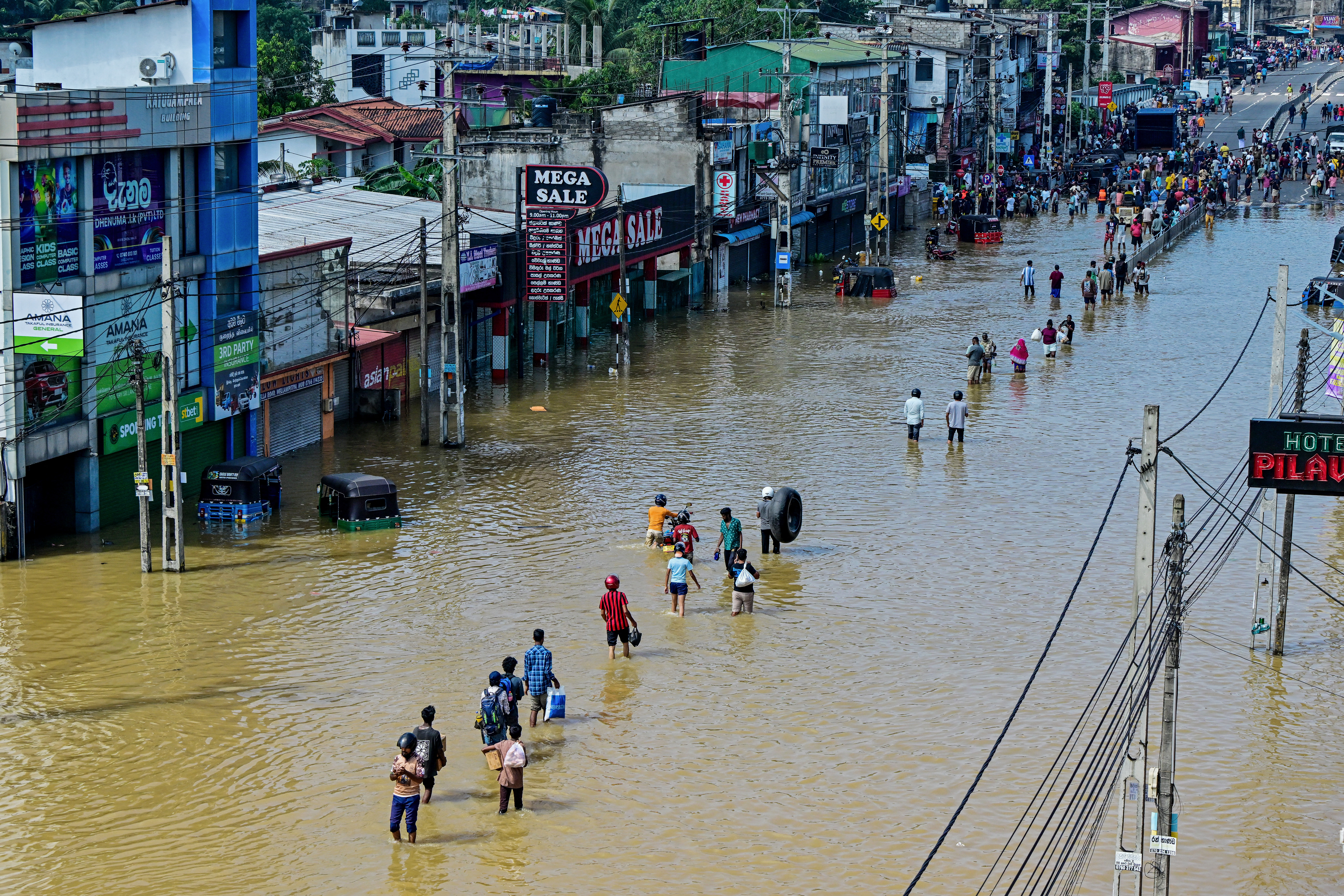
    Atlanta, where I live, recently endured a month-long drought. The rain that finally arrived was much-needed but, because of how dry the ground was, also triggered flood warnings across the region. Scorching heat has become common throughout the cooler months, and the increasingly powerful tropical storms that spin up the Atlantic coast have made conditions wetter, and thus more mosquito-ridden. Winters now feature warmer temperatures on average but are interspersed with sudden, polar vortexes that kill many of the Southern plants and animals unaccustomed to them.

    And, hard-to-believe as it may be, these changes pale in comparison to those felt in the Global South.

    The aftermath of a cyclone that hit Sri Lanaka, November 2025. (AFP via Getty Images)

    Fortunately, nature is resilient, and in the years ahead, humans will need to be too. 

    The lesson from the decimation of the Pacific Northwest salmon should be that no organism exists in isolation. We rely on one another, and when one species suffers, we all do. As our short-sightedness and greed exacerbate the climate catastrophe, the plants and animals around us will need our help more than ever. And, contrary to what the arrogant among us would have us believe, we will need theirs. 

    To survive, we need to return to practicing gratitude and reciprocity, as well as tear back the suffocating overgrowth of our current system—however daunting confronting the entrenched forces of money and power may be. Just as we now gaze back at institutions like slavery and wonder, what were people thinking, there will come a time when subsequent generations do the same—when our cruel, exploitative system is confined to textbooks, to be studied, with amazement, by people incredulous that their ancestors lived in a world that prioritized a fiction like money above their planet’s tangible wellbeing. 

    As we build new institutions that work to preserve life, we’ll mature from a group of competing saplings into a forest, transforming our world from one of scarcity to abundance. 

  • “Baldur’s Gate 3:” Gaming Done Right

    “Baldur’s Gate 3:” Gaming Done Right

    When I was little, my grandmother told me a story about a woman my uncle dated in college who played Dungeons & Dragons. The two reportedly had a deep connection and a happy relationship, until one day when she came out to him as an elf. My uncle, believing her to be joking, cheekily asked whether she had pointy ears. Unfortunately, far from finding the question funny, his girlfriend found it deeply insulting. She proceeded to speak about the grand, real world mission she had embarked upon, as well as the myriad races she was in eternal combat against. My uncle was stunned, and perhaps unsurprisingly, their relationship ended shortly after.

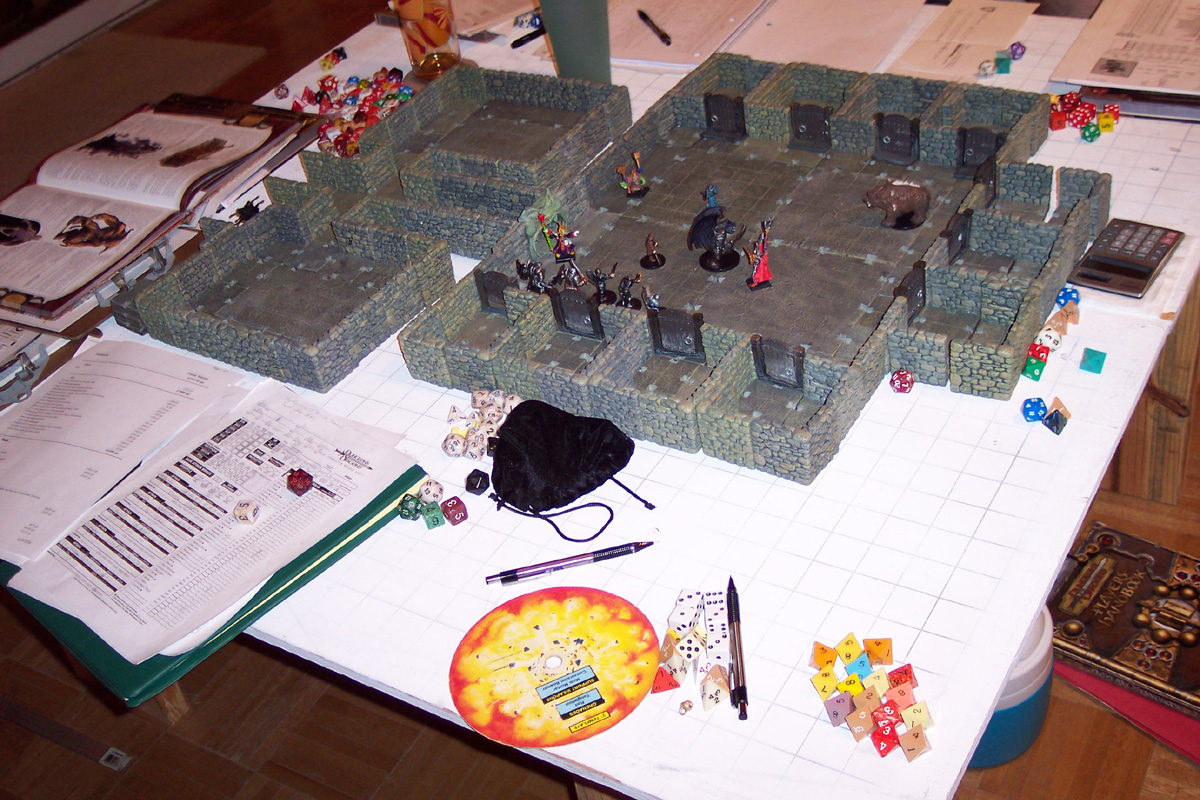
    A sample D&D game.

    As an evangelical, my grandmother shared this story to emphasize how fantasy was a slippery slope. The Devil, she whispered to me, works in crafty ways — one minute you think you’re playing a game, and the next, you’re convinced that you’re an elf. The only way to protect your sanity and avoid eternal damnation is, therefore, by avoiding anything and everything fantastical.

    Although certainly fascinating, I’m happy to share that this cautionary tale had little impact on me. I continued to smuggle Harry Potter books into my grandmother’s sleepy Adirondack home, and I even devoured a copy of Twilight beneath her roof one summer. And while I would’ve loved to receive a letter from Hogwarts or stumble into a chance encounter with a sexy vampire, I didn’t burst into flames for having those thoughts, nor did I seriously believe they would happen. This leads me to believe that my uncle’s girlfriend didn’t sign a pact with Satan, and instead, was likely working through some mental health struggles. But who knows?

    Regardless of the truth, I’ve been thinking about this story a lot lately. Not only because many far-right views seem to be increasingly gaining traction, but because I recently spent nearly 100 hours playing as an elf in Baldur’s Gate 3.

    Brainworms, Companions, and Elvish Circumcision

    Developed by Larian Studios, Baldur’s Gate 3 (BG3) is a direct adaptation of Dungeons & Dragons and uses the tabletop game’s Forgotten Realms mechanics and setting. Chief among these is a twenty-sided die, which determine your success in everything from combat to dialogue. Prior to BG3, I had only played D&D once years ago, so much of this was new to me. But after some trial and error, the systems became second nature, and I quickly became engrossed in the world of Faerûn.

    My uncle’s ex would almost certainly be familiar with polyhedral dice; they resolve events in D&D.

    The premise of Baldur’s Gate 3 is quite simple. After a parasitic brainworm infects you and your companions, you embark on a race against the clock to find a cure. Predictably, this ends up being more convoluted than it sounds, and the plot thickens in many meaningful — and sometimes surprising — ways. But while I loved the story and the myriad options players have to navigate it, the companions were — and continue to be — my favorite part of BG3.

    I grew up playing RPGs and story-driven FPS titles (that’s role-playing games and first-person shooters, for the uninitiated), and I spent a good chunk of my adolescent years exploring worlds with Kaiden Alenko in Mass Effect, debating morality with Kreia in Star Wars Knights of the Old Republic II, and fighting the Combine with Alyx Vance in the Half-Life series. These fictional beings had a profound impact on me, and while I still think of their stories to this day, Larian has managed to create a character ensemble unlike no other.

    From Shadowheart, a cleric who worships the goddess of darkness, to Gale, the eloquent wizard who I ended up romancing, each of the ten recruitable companions has a unique story, as well as perspectives that dictate their feelings towards you. Want to stop to help a group of refugees, even to your own detriment? Gale might appreciate doing so, but Astarion, a manipulative vampire with a complex past, probably won’t. Tired of trying to negotiate your way past a pair of guards? You can always just attack them — an act that Lae’zel, a battle-hardened githyanki warrior, will almost certainly approve of. While the diverse strengths and weaknesses of your companions makes progressing through fights incredibly rewarding, their personalities and stories outside of combat are what really make them shine.

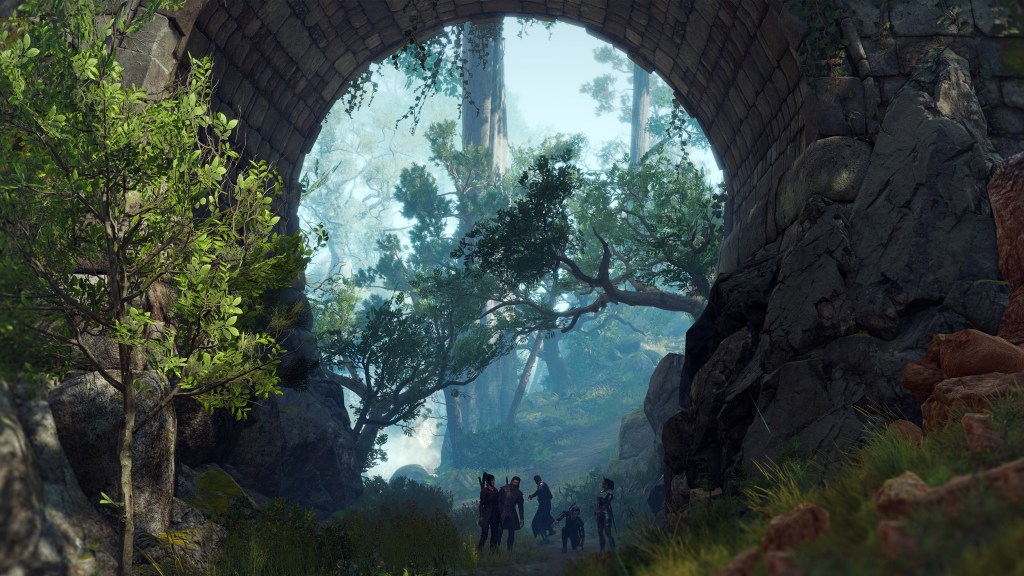
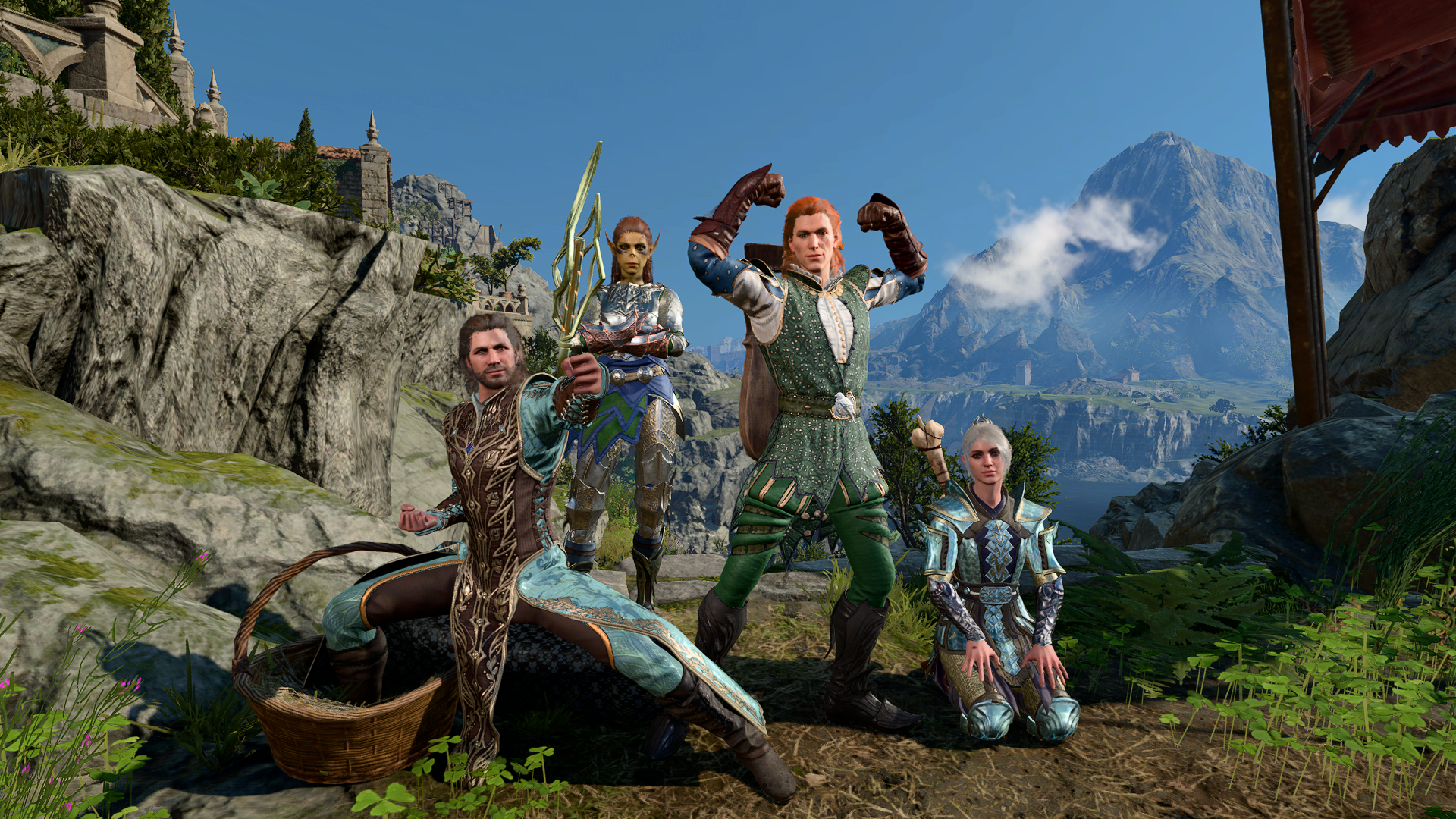
    My elf character alongside Gale (far left), Lae’zel (back left), and Shadowheart (right).

    Amazingly, Larian also chose to extend this care to almost every non-companion character you encounter. The studio worked with over 240 voice actors for the game, helping everyone from goblin raiders to the neighborhood hag not just look compelling, but sound so too. While I’m often prone to skipping lengthy dialogue scenes, I found myself actively listening to almost everything in BG3, just to soak it all in.

    There are so many other aspects of the game worth gushing about, such as character creation. (Besides selecting a race, class, and origin, you even choose your character’s genitalia. I wonder how my grandmother would feel about me spending an afternoon debating whether elves practice circumcision.) But after recently wrapping up my first playthrough as a pointy-eared elvish bard, I think it’s worth highlighting what makes Baldur’s Gate 3 such an important game in 2026.

    Swimming Against the Tide of Enshittification

    I’ve written previously about the depressing state of the modern gaming industry. Video games have gone from products to services — from items you buy once to tools designed to extract ongoing investment. This has allowed companies to enshittify entire series, alienating longstanding fanbases and setting worryingly low new standards in the process.

    It’s also worth mentioning that video games have, historically, catered to heterosexual men, with the desires of women, LGBTQ+ people, and other minorities being little more than afterthoughts. In recent years, I’d argue that many of the biggest enshittifiers have been able to don masks of Progressivism, whether through adding shallow queer romances into games or slapping Pride colors onto their company logos once a year. Like so much of “corporate responsibility,” this veneer serves a dual function; besides appealing to minority players, it works to hide labor abuses, industry consolidation, and the often bigoted beliefs of company executives.

    While no game is perfect, Baldur’s Gate 3 still manages to feel like a breath of fresh air against this backdrop of decay.

    Unlike just about every other modern title, BG3 was released as a complete product. There’s not a lick of DLC (downloadable content), paywalled mechanics, or — God forbid — cosmetic additions; buying the game lets you own it in its entirety. Now, no launch is flawless, and bugs and balancing issues were certainly present upon BG3‘s release in Summer 2023. But over the years, the game has seen several massive patches, and most players today appear satisfied with its state.

    Far from cheap virtue signaling, Baldur’s Gate 3 is also a masterclass in true inclusivity. All companions are “playersexual,” meaning they’re open to romance regardless of their gender. Outside of diversity, BG3 also explores deep topics like trauma and abuse, with several characters grappling with complex issues from their past. The best part is that, in many ways, all of this is both meaningful yet inconsequential. If you want to romance one — or more — of your companions or help certain characters process past trauma, you can. Alternatively, you can avoid it all and just progress through the main parts of the story. It’s completely up to you.

    Larian’s genuine care for Baldur’s Gate 3 is evident, and I believe much of this is due to the company’s independent status. The studio’s head of production, David Walgrave, said it best: “We don’t have shareholders, but we also don’t think about them.”

    Translation: When there aren’t vulture hovering over you, rushing deadlines or screeching about the bottom line, you can take the time to craft something truly meaningful.

    Charting a Path Forward

    While writing this essay, I learned that the Dungeons & Dragons IP is owned by Wizards of the Coast (WOTC), a Hasbro subsidiary. If you’re also skeptical of almost every large corporation these days, it probably won’t surprise you to learn that WOTC has seen multiple rounds of recent layoffs, including nearly 90% of D&D‘s virtual tabletop team. Hasbro’s CEO, Chris Cocks, has also spoken positively about AI, specifically saying how Hasbro — and WOTC, through extension — will use it “significantly and liberally.” As D&D has always been an imaginative, indie space where people can unleash their creativity and bond with other fantasy-lovers, I find this particularly egregious.

    Last December, Larian Studios announced their next title: Divinity. While I’m less familiar with the Divinity series, it’s reassuring that Larian fully owns the IP, as it should free them from the constraints they likely faced when producing Baldur’s Gate 3. Hopefully, the studio can continue to offer players thoughtful gaming experiences, even as institutional rot becomes more apparent than ever.

    As I conclude my first playthrough and begin planning my second, I can’t help but wonder whether my uncle’s ex has played, or even heard of, the wonder that is Baldur’s Gate 3. I hope that she has, just to live out the elvish fantasy that — clearly — had a large impact on her younger years. Maybe someday, I’ll raise a glass to her, throw it back, and sit down with my grandmother to explain why imagining yourself as an elf — yes, with pointy ears, a queer lover, and a parasite in your brain — can actually be beautiful.

  • Opposing ICE Makes You a Domestic Terrorist

    Opposing ICE Makes You a Domestic Terrorist

    This past weekend, CBP officers murdered Alex Pretti in Minneapolis. The videos that captured the event are harrowing; they show Pretti — with one hand holding his phone and the other above his head — attempting to aid a woman being pepper-sprayed before being thrown to the ground, beaten, and shot several times. Bystanders who witnessed the crime and sought to check on Pretti were refused access to him, and the videos end with screams and cries.

    In a saner world, the officers involved would be placed on leave while a full, independent investigation is conducted. Politicians would call for calm but would doubtlessly express sympathy over the killing — particularly when the victim was an ICU nurse at a VA hospital who sought to “make a difference in the world.” But instead, we’ve seen the opposite, with the Administration’s response being just as swift and depraved as when ICE officers murdered Renee Good two weeks ago.

    Pretti, like Good, wasn’t protesting a fascist state or trying to stop a fellow citizen from being brutalized. He was a “domestic terrorist” who sought to “murder federal law agents,” and any politician or citizen who defends him — or even raises questions — is just as guilty. The group of heavily armed officers that beat and shot Pretti found a (legally-obtained and carried) weapon on him, which justifies the murder and shows that they merely acted in self-defense. Thus, a thorough inquiry into the killing is unnecessary, which is why the Department of Homeland Security has decided to block local police from investigating.

    Provided you have a shred of critical thinking skills, the excuses coming out of the ghoulish mouths of Kristi Noem, Stephen Miller, and Gregory Bovino are laughable. From Kyle Rittenhouse to Mark and Patricia McCloskey, there are numerous instances of right-wing figures who didn’t just carry guns to protests, but brandished and used them against protestors. Were these individuals called domestic terrorists? Not exactly.

    Kyle Rittenhouse — who crossed state lines, killed two protestors, and injured one other — was celebrated by the Right, scoring meetings with Donald Trump, Tucker Carlson, and the late Charlie Kirk’s Turning Point USA. Likewise, Mark and Patricia McCloskey were similarly hailed as heroes, receiving invitations to the 2020 Republican National Convention to — you guessed it — defend the Second Amendment.

    While bringing a weapon (again, legally obtained and carried) to a protest certainly speaks to the tumultuousness of our times, it’s not illegal, nor is there any indication that Pretti had any intention to draw, brandish, or otherwise use it. But this is the era of Alternative Facts, where you can repeat something enough times and with enough conviction that people start to believe it.

    For those of us who still maintain a grasp on reality, Pretti’s murder should make a few things clear.

    First: We live in a system where most people must obey the law, despite not being protected by it, while a small number enjoy its protection, but don’t need to obey it.

    Rules for thee, but not for me. While Pretti and Good (and many of the others killed by federal law enforcement over the past 12 months) committed no crimes, they’re still guilty, because criminals simply are. Likewise, despite their blatant guilt, masked and murderous law enforcement agents (like sex predator politicians) are automatically innocent. Any accusations or charges leveled against them are baseless or conspiratorial.

    As many marginalized groups know, the criminal justice system has always been imperfect at best and inhumanely cruel at worst. But as authoritarianism spreads, the brokenness of the system is becoming increasingly apparent.

    Second: ICE needs to be abolished — not reformed, not put through a comprehensive training program, but stamped out of existence.

    The agency was founded in 2003 after 9/11, which means that most adults alive today have lived through pre-ICE times.

    While it’s had numerous controversies throughout its two decades of existence, 2025, in particular, has shown the agency’s utter disregard for the law. From detaining green card holders and citizens to deporting immigrants with no criminal background, ICE abuses (along with those committed by CBP and other DHS entities) are numerous and well-documented.

    Far from facing a modicum of accountability, the agency now receives more funding than every other federal law enforcement branch combined, and hundreds of Republican and Democratic politicians recently voted to give ICE “gratitude.” Seven Democrats supported a bill that gave an additional $10 billion in funding to ICE just last week. And new recruits who receive little to no training enjoy goodies like $50,000 sign-on bonuses and student debt cancellation (something the Right has demonized as “socialism” for years).

    Abolish ICE.

    Third: Know that the pursuit of profit is almost always a driving force behind whatever abuses, murders, and lies occur.

    As many of us direct our ire towards family members with Fox News-addled brains, healthcare is defunded, environmental protections are slashed, and politicians vote to funnel more and more money into the President’s personal Praetorian Guard. ICE, specifically, has an extensive portfolio of private contractors, from for-profit prisons and surveillance companies like Palantir to Amazon, AT&T, and so many others.

    We live in a world where cruelty is profitable.

    Fortunately, large swathes of the public are disgusted with what’s happening, making now the perfect time to channel that energy into fighting, not posing, for change. The tens of thousands of people marching through below-zero temperatures in Minneapolis are an inspiration, and Americans across the country should support the calls for a larger, general strike. In the meantime, consume less, particularly from companies that profit from wickedness.

    Numerous figures and organizations have published detailed guides on specific ways to have an impact, and many are great resources that can help you identify a niche. But, in general, remember that anything is better than nothing. Joining a DSA branch, volunteering at a soup kitchen, even joining a local environmental group — it doesn’t have to relate to immigrants, but doing something will feel infinitely better than doomscrolling as the world crumbles around you.

    This February, I’m participating in a 5k through UNRWA that’s raising money for children’s mental health services in Gaza (donation page here, if you’re able to give anything!). I’m looking forward to it for many reasons, but mainly because I’m excited to do something, even if that means running 3.1 miles on Valentine’s Day.

    Alex Pretti, Renee Good, and the many others who’ve been targeted, assaulted, and killed by federal law enforcement deserve justice. While we can’t bring them back, we can hold the people responsible accountable and care for one another as we work to build a better world.

  • From Player to Customer

    From Player to Customer

    While I’m only 30, I increasingly feel like I’m in a nursing home, complaining to my grandkids about how things used to be as they lead me to the bathroom because I shit myself.

    “Kids, when I was your age, video games used to be products, not services,” I tut. “You’d buy a game and own it outright; none of this DLC crap.”

    “Sure, grandpa…” my granddaughter says after cleaning me up. “Let’s get you back to bed.”

    Video games were an integral part of my childhood, and I have vivid memories of walking to Target with my dad to buy titles like The Sims 2, Fallout 3, and Mass Effect — all for PC DVD-ROM. After running home and installing whatever I’d bought, I’d then immediately start playing. I owned physical copies of these games, and even if I’d leave them out of their cases, causing the discs to get scratched (as I often did), they were mine.

    In the early-to-mid 2000s, series like The Sims began to gradually increase the number of expansion packs they released. While I found this frustrating (as my dad did too; he, after all, funded my gaming addiction), these expansions generally added exciting new features to games. My Sims, for example, went from living in sprawling mansions and perennial summers to apartments with pets, as the seasons changed and they danced at clubs every night. During this era, video game companies — including larger corporations — seemed genuinely interested in making fun products for their customers, and the love for their creations shone through in the final products.

    But as I blinked and two decades flashed by, something changed.

    While I still enjoy gaming, every title I play today I launch through Steam, which, while convenient, means I don’t technically own my games. Instead, I purchase licenses to play them — something that Valve could yank away at any time. (Amazon did this exact thing to Kindle users when it removed, of all titles, 1984.) My custom-built computer doesn’t even have a DVD drive, and microtranscations from the frivolous to the insulting have infested series as distant as The Sims and Assassin’s Creed.

    Often, this desire for profit is evident not just in bloated menus clogged with advertisements, but in the quality of games themselves. While digital artists continue to pour their hearts into their creations, executive boards frequently push studios into releasing half-baked, buggy titles that feel lightyears away from being customer-ready. Series like The Sims have shifted from products to services; from something you purchase once and enjoy to something designed to extract ongoing investment.

    Today, many games have entire portions of content locked away, only to be sold back to customers in subsequent DLCs. Depending on the title, players can expect to invest hundreds — and sometimes even thousands — of dollars to play games in their entirety. And while some releases are so abhorrently barebones that companies are forced to grunt out half-hearted apologies, many seem content to screw people over.

    Why? Because they can.

    As Cory Doctorow explains in his book Enshittification:

    Companies don’t treat you well because they’re “good” capitalists, and they don’t abuse you because they’re “bad” capitalists… Companies abuse you if they can get away with it.

    Companies like Electronic Arts, Activision Blizzard, and Embracer Group have been allowed to gobble up competitors, mistreat their workers, and erode trust with loyal players. EA, in particular, stands as a bleak example of corporate greed — the company went from funding innovative titles to ruining longstanding series like SimCity. As of writing this, EA is poised to be acquired by Saudi Arabia’s Public Investment Fund (PIF) in 2026. If the deal proceeds, the $55 billion buyout would give the despotic regime ownership over 93.4% of the company, with the remaining 6.6% going to Silver Lake and Affinity Partners — the latter of which was founded by none other than Jared Kushner. (And notably, the PIF is already a “significant investor” in both firms).

    As a longtime video gamer, all of this is depressing, but you don’t have to look far to find other industries where corporate ghouls are living out their wettest, wildest, and most exploitative dreams. Digital design software paywalling color packs; tech giants fighting tooth and nail against Right to Repair legislation; streaming services that now have ads unless you pay more. Enshittification is ubiquitous, and it’s forcing us to spend money on purchases and subscriptions that would’ve seemed absurd just a few years ago.

    In protest, I’ve begun making the shift back to physical media wherever possible. While making space for boxes of video games and Blu-ray discs is far from enjoyable, I see it as a necessary evil — I’d rather create clutter than give another cent to the companies hollowing out what we used to enjoy. And while drawing a line in the metaphorical sand feels empowering, it’s crucial to recognize that individual choices alone won’t impact the powers at play. EA, after all, is being acquired for 55 thousand million dollars.

    As Doctorow highlights in his book, escaping the depths of enshittification hell will require a combination of four factors:

    1. A return to staunch antitrust enforcement (something we briefly saw under FTC Chair Lina Khan)
    2. Strong competition that keeps companies innovating, instead of abusing
    3. Empowered workers that can restrain executive overreach
    4. Interoperability that lets us own, repair, share, and do whatever the fuck we want with the products we purchase

    We’ll never be able to convince the handful of ketamine-addled sociopaths wrecking society to care about us. Instead, we need to demand it through legislation and worker power. And while things in the United States may seem bleak at the moment (Trump is almost certainly the embodiment of political enshittifcation) the movement to check corporate greed is growing across many parts of the world.

    I’ll always be a gamer, and despite disappointing trends, I’ve still been able to find incredible titles that have made me feel like I was a child again, unopened copy of a new video game in-hand. But I look forward to the day when video game companies — and corporations in other industries — are forced to show us the dignity we deserve.

  • As the Establishment Poses, the Left Builds

    As the Establishment Poses, the Left Builds

    If there’s one takeaway Americans should have in 2025, it’s that establishment Democrats are incapable – and, evidently, unwilling – to meet the moment. This year, in particular, has been rough.

    As fascism seeps deeper into the country’s foundation, leading Democrats have responded by embarking on Sorry I Lost book tours, snapping plastic crowns, and putting on rhetorical performances. At the same time, they’re posing with war criminal Benjamin Netanyahu, short-circuiting when asked about AIPAC donations, and acquiescing to the same policies they’re decrying. 

    Fortunately, while the rot is clear, so too is the path forward.

    A year ago, Zohran Mamdani was an unknown figure, polling at 1%. This past week, he was elected mayor of New York City and has become one of the most recognizable faces of a movement determined to resist the pervasive hatred, greed, and ignorance of our times. His victory confirmed what many on the Left already knew – that the path forward isn’t through theater masquerading as politics, but through a relentless, grassroots fight for the betterment of the working-class. A movement grounded in material benefits – not symbolic gestures – is one built to win. 

    And while Mamdani is an inspiring figure, his success isn’t the only victory worth celebrating from this past week. In Atlanta, Kelsea Bond’s campaign for District 2’s City Council seat similarly built up enough grassroots energy to win a commanding victory.

    The Fight for The City in a Forest

    Bond’s platform shares much in common with Mamdani’s, with both centering the building of a livable city through affordable housing, sustainable infrastructure, and an expansion of workers’ rights. Like Mamdani’s, Bond’s campaign knocked on thousands of doors and received endorsements from the Working Families Party, local unions, and numerous other organizations and figures. There’s also a similar sense of urgency, as the past several years have been difficult for Atlanta.

    Despite fierce resistance from organizers and over 100,000 residents calling for a referendum, city leaders approved Cop City (officially the Atlanta Public Safety Training Center), and the facility opened this past April. On top of such blatantly undemocratic decision-making, citizens have also been dealing with an affordability crisis as local rent prices soar and wages stagnate. This has forced long-term residents out of areas like Bond’s District 2, while Atlanta’s fractured transportation network and abhorrent traffic – the fifth worst in the country – have made their exodus permanent.

    Community Building Through Resistance

    The Wednesday before their victory, Bond’s vision came into focus during a panel with Daniel Aldana Cohen, coauthor of A Planet to Win: Why We Need a Green New Deal, and Elise Joshi, a fellow activist and organizer. Throughout the hour-long conversation, Bond spoke on their motivations and articulated how their platform seeks to connect climate action to housing, public transit, and civic power.

    “For so many young people in Atlanta, [Cop City] really demonstrated the lack of democratic processes that exist in Atlanta politics,” they said. “People can see the contradictions that exist in the Atlanta government, and that’s contributed to the energy around our campaign.”

    While city councilors fight for local change, the issues they combat often mirror national dynamics. Bond spoke to this, highlighting how establishment politicians often work together to protect capital, regardless of party.

    “In an ideal situation, we would form a Big Tent alliance against fascism in the Trump regime,” Bond said. “Instead, we’re seeing the Atlanta establishment – traditionally centrist Democrats – aligning themselves with Republican City Council members and throwing progressives under the bus.”

    In the face of such collusion, grassroots movements provide hope, but they also offer a less-discussed benefit. As the loneliness epidemic worsens and society, at large, fractures, organizing can help alleviate atomization. Bond addressed this, emphasizing that community-building was foundational to their campaign.

    “I learned very early on in organizing that people will not stick around if they’re not having fun,” they said. “That’s why it’s been so crucial since the launch of our campaign to keep [our movement] fun and ensure that people are making friends and connecting with new people.”

    Cohen agreed, quipping that phones are like tiny suburbs in our pockets – isolating, yet for many people, the only way they experience politics.

    While extensive canvassing efforts helped propel Bond to victory, their campaign also hosted concerts and comedy shows to foster community. These helped break down social silos – which can often feel entrenched in Atlanta, due to its car-centric infrastructure – while working to tackle the city’s chronically low municipal turnout. 

    “I grew up in the DIY music scene in Atlanta, and I know they’re all left-wing. I know they’re all mad at our city government for Cop City. And so, we’ve really been trying to tap into those spaces to bring people in who otherwise wouldn’t see any reason to vote.”

    Whether or not fed-up indie artists were the deciding factor, Bond’s campaign tactics proved more than just successful. 6,715 local residents voted for them, earning a 64% victory and avoiding a potential runoff.

    And what did Bond’s supporters vote for? Density – not as a buzzword or a piece of urbanist jargon, but as scaffolding to help connect people to their communities. 

    “Every single person deserves to live close to where they work, not just to improve the quality of their life, but because it makes it easier to organize in your community,” Bond said. “It makes it easier to be civically engaged. It makes it easier to plan a meeting with your coworkers when you don’t have to drive an hour to meet at the same place.”

    Beyond District 2

    While Atlanta may not have a democratic socialist mayor, Kelsea Bond’s city council win is one the Left should celebrate. Like Zohran Mamdani, Bond ran an inspiring grassroots campaign, and their victory serves as a much-needed reminder that progressive forces can win when they fight for commonsense policies, work to repair fractured communities, and offer voters genuine hope. 

    At a time when national politics have rarely felt more hollow – when centrists pose and flounder against cartoonishly evil forces – Bond’s blueprint to success is one worth emulating.

  • Transit Dreams: A Diary

    Transit Dreams: A Diary

    From Issue One of Alternative Webs, releasing soon.

    Atlanta

    I board the train, first taking in the smells. Old Spice and weed, most likely? It could be worse. A man sits near me, a full rotisserie chicken in-hand. That throws a new smell into the mix. We start moving as a static-garbled voice belts out our final destination.

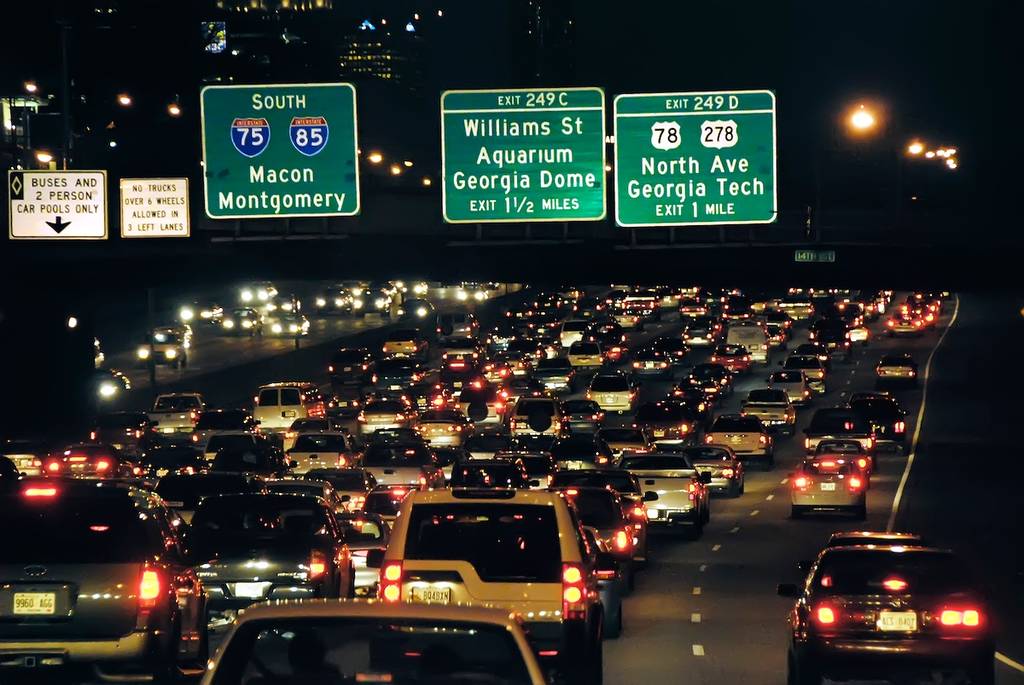
    The train passes over a highway clogged with commuters returning home. I try to calculate how many cars I’m looking at – 300? 500? I wonder whether the people in them drive to work every day. How much time does that eat out of their lives? I don’t have answers, and city planners probably don’t either. They should, though.

    Early 2000s hip-hop plays through my headphones as I fly above the asphalt doomscape beneath me, ruminating. All the world’s ills, sittin’ on chrome 24-inch wheels. Numerous podcasts and audiobooks undoubtedly play beneath me, the drivers trying their hardest not to crash.

    As the train approaches my station, I gather my belongings, double-checking that I have everything. Phone, wallet, keys – yes, all there. The doors open and I step out as another man steps in, dragging his entire livelihood behind him in a tattered blue IKEA bag.

    I watch him disappear down the aisle as I walk away.

    Nanjing

    Air conditioning blasts throughout the car, fighting a fierce battle against the oppressive heat and humidity outside. As the lush greenery of Xianlin disappears behind me, I arrive at my transfer station. Three minutes until the next train – I’ll need to run. I make it, slipping through the doors with seconds to spare, and take a seat. The train begins hurtling towards the beating heart of the city.

    Students returning home laugh and chat. Tired workers scroll on their phones. An older man boards the train halfway through the trip – I stand up to offer my seat, but he smiles and shakes his head.

    I spend an hour decompressing, listening to Amy Winehouse and the Big Little Lies soundtrack. Halfway through the journey, Spotify stutters. I check my phone – what’s going on? Ah – VPN crash. I reset it, and the music resumes.

    I think of my upcoming trips to Hong Kong and Thailand. Of the long day at work I’ll have tomorrow. Of being thousands of miles away from home.

    The speaker chimes: “鼓楼站,到了。”(Now arriving at Gulou Station.)

    Maybe I’m not that far from home.

    Istanbul

    The third iteration of the adhan, Asr, has just begun. The muezzin’s voice echoes across the city, reverberating across two continents and the gray waters between them.

    Ash-hadu an la ilaha ill-Allah.

    As the devout pray, I board a tram running through the center of the congested streets, struggling to stand amongst the throngs of people in the packed car. A group of fashionable teenagers in leather jackets and Adidas sneakers are on their way to a concert. They jostle for positions as we begin moving.

    Ash-hadu anna Muhammadar-Rasulullah.

    Over the heads of those around me, I watch a chilly breeze toss seagulls around the dark, late-afternoon sky. A solitary ray of sunshine breaks through, illuminating a portion of the twinkling sea beneath it.

    The tram rolls forward as a man beside me mutters Turkish into his phone. The woman across from me clutches her headscarf. I stare out at the sea.

    Somewhere behind the clouds, the sun begins to set. I’m disoriented – is it setting over Asia? Europe? Maybe it doesn’t matter.

    The tram continues moving, as do I.

  • In the Presence of Giants

    In the Presence of Giants

    When I was nine years old, I traveled with my dad to visit an aunt and uncle who live on the Island of Hawaii1. For most people, the words “Hawaiian vacation” connote images of luxurious, White Lotus-like accommodations. But far from staying in an opulent beachfront complex, we pitched a tent in the backyard of their cozy Hilo home.

    Located on the windward side of the island, Hilo is one of the wettest cities in the United States. Suffice to say, while lucky travelers can catch moments of sunshine, it’s generally not the place to visit if you’re hoping for a sunny beach vacation. What Hilo does offer, however, is serenity. Every night of my trip, I would fall asleep to the soft pitter-patter of rain bouncing off our tent’s roof, while geckos chirped their nighttime chorus.

    ‘Akaka Falls, 11 miles north of Hilo. (2024)

    Throughout the two weeks I was in Hawaii, I snorkeled through volcanic tide pools, saw sea turtles basking on black sand beaches, and explored some of the most rugged natural beauty imaginable. I also saw whales. Lots of them.

    Where the Giants Swim

    The warm Hawaiian waters house a cornucopia of marine life, but in winter and spring, they’re home to a special seasonal visitor: humpback whales. These gentle giants embark on annual voyages from their Arctic feeding grounds to the warm, tropical waters of Hawaii to give birth. Fittingly, these journeys have given whales important roles in native Hawaiian culture. Hawaiians call humpbacks and other large whales koholā and have honored them as ʻaumākua – spiritual guardians who can assume the shape of animals, plants, and various natural phenomena.

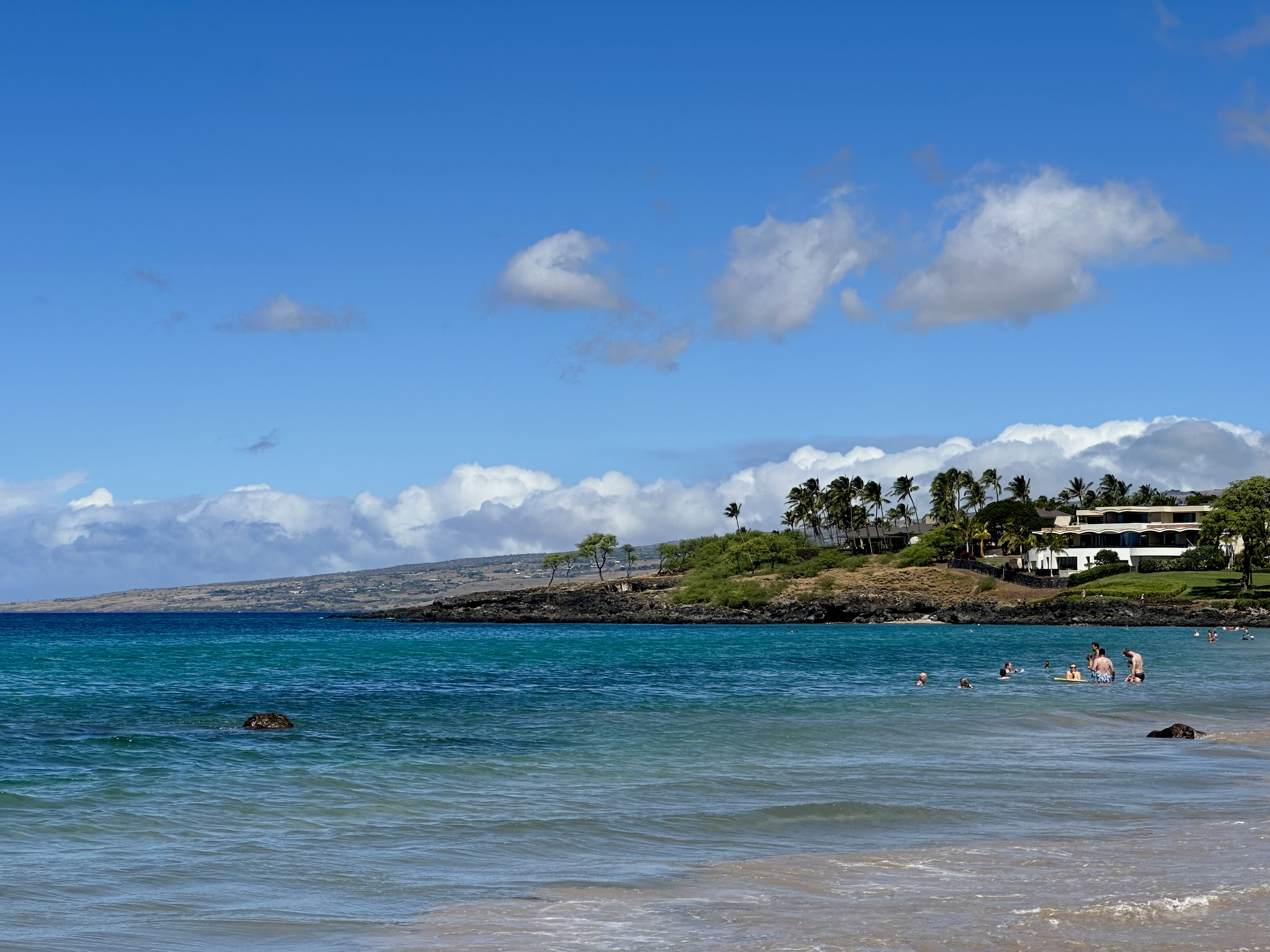
    Hāpuna Beach, a popular destination for swimming, snorkeling, and whale watching. (2024)

    By the time I was nine, I’d already been a whale fanatic for years and hoped to work as a marine biologist when I was older. To my utter joy, I lost count of how many humpbacks I saw within a few days of my trip. I remember driving along the coast and seeing them out in the sparkling blue expanse. At beaches, I would spot their tail flukes and flippers saluting me from a distance. And I even saw several whales breach – propelling their massive, 40-ton bodies out of the water and into the air.

    At the time of my trip, I also had a fascination with the animals of the African savannah, particularly with elephants. But my trip to Hawaii was the first time I came face-to-face with one of Earth’s great leviathans, a being I’d previously only read about. To call it a transformative experience would be an understatement: it opened my eyes to the wonders and diversity of life at a young age. I, a skinny 60-pound kid, saw 50-foot whales in their natural habitat. Today, the trip stands out as one of the first times I recognized the preciousness of life – all life.

    Into the Mist

    Over the following 20 years, I lived a whale-less life, until last summer when I visited the Pacific Northwest to see two friends. Alyssa, a fellow writer and creative who I met in China, has lived in Oregon with her partner Keegan for the past several years, but neither of them had explored much of the state’s stunning coastline. So together, we embarked on a road trip along the coast, regularly stopping to soak up the picture-perfect views. Our main destination, however, was Depoe Bay.

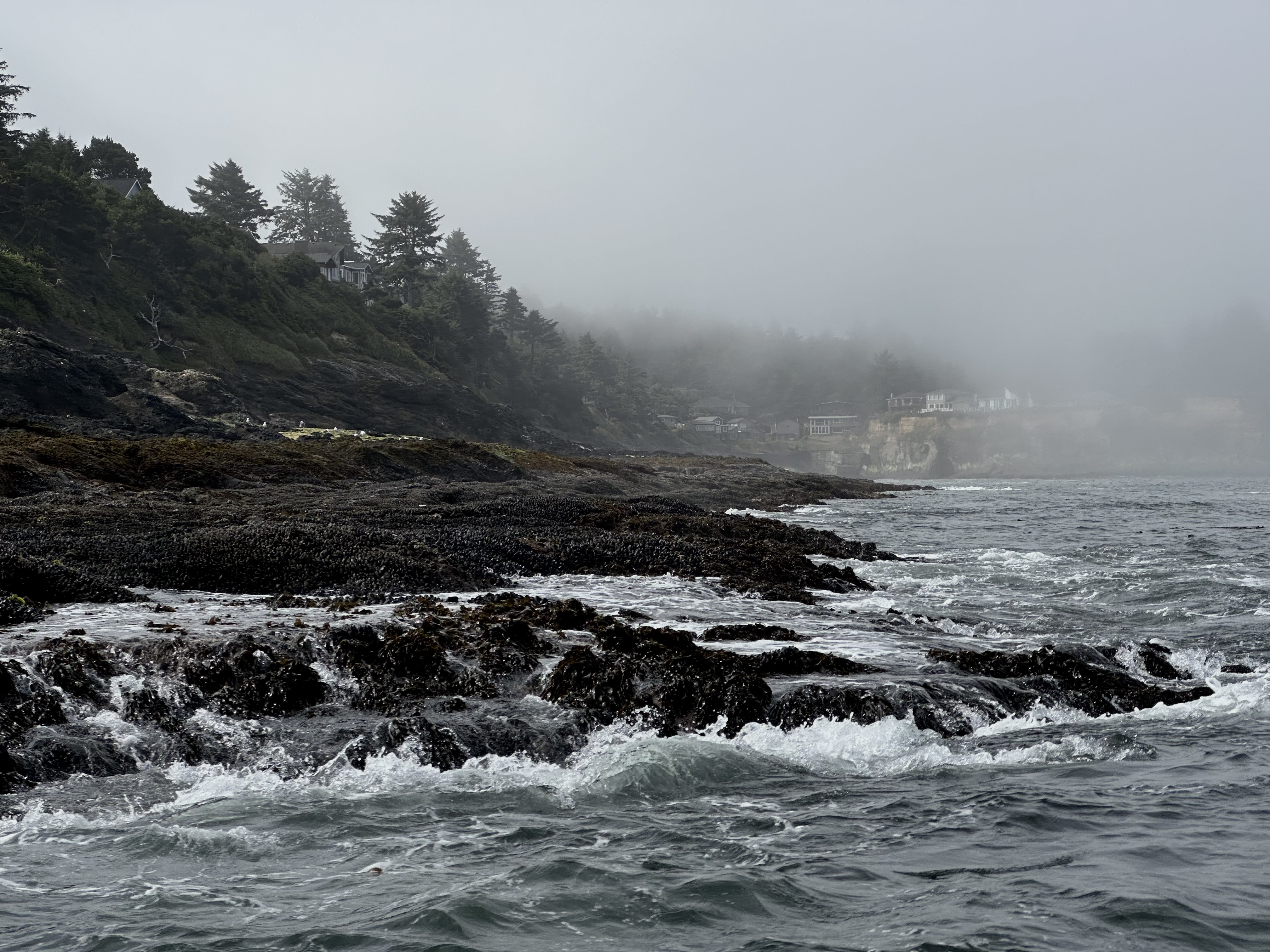
    The rocky, mist-drenched coastline of Depoe Bay. (2024)

    A sleepy town often covered in mist, Depoe Bay looks like something out of Stephenie Meyer’s Twilight novels. But besides housing a collection of quaint shops and restaurants, the town is also home to a renowned museum and whale watching center, Whale Research EcoExcursions. Run by retired marine biologist Carrie Newell, the company specializes in introducing people to the migratory gray whales that pass by Oregon each summer. Throughout her career, Newell discovered key insights about the whales, including the fact that they come to Depoe Bay, specifically, to graze on local shrimp populations. Today, her company offers people the chance to see the gentle filter feeders up close – an opportunity we couldn’t resist signing up for weeks in advance.

    On the morning of our tour, we listened to an orientation on gray whales before boarding a tiny inflatable boat and cruising out of the bay. Visibility is, of course, key when it comes to whale watching, so it was initially disheartening to begin the trip under a dense fog cover. While visual cues aren’t always as obvious as a breach, signs like hovering birds or distant spouts of water can also indicate a nearby whale. But we couldn’t see a thing. Fortunately, around halfway through the trip, another vessel reported spotting a whale, so we quickly rode over to try to find it. For the next half hour, we drifted through the dense fog bank, ears perked for distant splashes or spouts. We floated in silence, the ocean holding its breath along with us.

    Eventually, our patience paid off. A juvenile gray whale named Creamsicle greeted us, emerging from the depths just feet away from our boat. The first appearance was quick, but we watched, entranced, as they surfaced again and again. While they never breached, their size, movement, and presence made the encounter not just memorable, but sacred. Eventually, they disappeared back into the gray expanse, and we made our way back to shore through the salty air. The fog began to lift.

    Creamsicle the gray whale surfacing near our boat. (2024)

    Following the Oregon trip, I had the chance to participate in another whale watching tour, this time in Seattle. While the vessel we travelled on was much larger than the inflatable we’d boarded in Depoe Bay, we still saw orcas, porpoises, and yes – a humpback, as we cruised around the Puget Sound. After the tour, I felt a quiet joy, as though I’d come full circle. I’d gone from being a nine-year-old kid who felt lucky to have seen humpbacks in Hawaii to an adult who had made whale watching into an annual pilgrimage.

    Whale Watching, Responsibly

    I’m still learning about the ecological impact of whale watching, but it’s clear that the noise pollution generated by boats can interfere with the ability of whales and other cetaceans to hunt and communicate. While many modern vessels claim to dampen the noise they generate, not everyone buys it, with some accusing whale watching companies of greenwashing. It seems the most responsible observation, then, is done from shore – ideally with a good pair of binoculars. At a minimum, if you join a whale watching tour, try to partner with a company mindful of its environmental impact, or with one that features tours led by a marine biologist, like Whale Research EcoExcursions.

    Nevertheless, I’d argue that the benefit of seeing these creatures offers intrinsic value, particularly as human action harms them. This past year, I was heartbroken to read that at least 80 migratory gray whales starved to death off the coast of Baja, California, on account of disruptions to their Arctic feeding grounds. The same researchers also observed fewer calves being born, as well as a much higher frequency of emaciated adults. I firmly believe that if more people had the opportunity to observe animals in their natural habitats, understood the essential ecological role every species plays, and recognized how climate change harms them, collective movements would unite to end this madness. (As always, it’s worth pointing out that stopping the destruction of the biosphere is already technologically feasible – what’s lacking is political power.)

    Although the nine-year-old whale fanatic in me hates reading about gray whale starvation, the realist in me understands that doing so is essential. You can’t stop something you don’t care about, nor can you end something you don’t understand. In the years ahead, we’ll all need to channel both our inner child and our realist adult to foster meaningful change.

    A Candle in the Dark

    When I’m feeling nihilistic, it helps to remind myself of the wonders we share the planet with. Humpback whales that sing ethereal songs in the cerulean depths. Orca pods that have distinct cultures. Gray whales, like Creamsicle, that embark on 10,000-mile migrations across the sea. It’s hard not to be blown away seeing these animals in the wild, because even from a distance, their intelligence shines like a beacon. I believe the world would be a gentler place if more people went whale watching, but beauty is everywhere – and not limited to marine mammals – if you know how to look.

    Earlier this year, my partner and I decided to spruce up our garden. While we couldn’t bring the tropical coral reefs of Hawaii to Atlanta, we did add zinnias, sunflowers, and several other plants to our small backyard. We now share the space with pollinators. Lots of them.

    Fluttering hummingbirds now zip from bloom to bloom, fuzzy bumblebees somersault through bushes, and majestic butterflies spend entire afternoons probing for nectar. The world might often feel overwhelming, but I can still stand at my window and observe an entire playground of nature. So these days, I put my ear to the ground, listening for where I can make the most meaningful impact, while appreciating the other forms of life that are my neighbors. And, of course, by taking advantage of every opportunity that lets me see more whales.

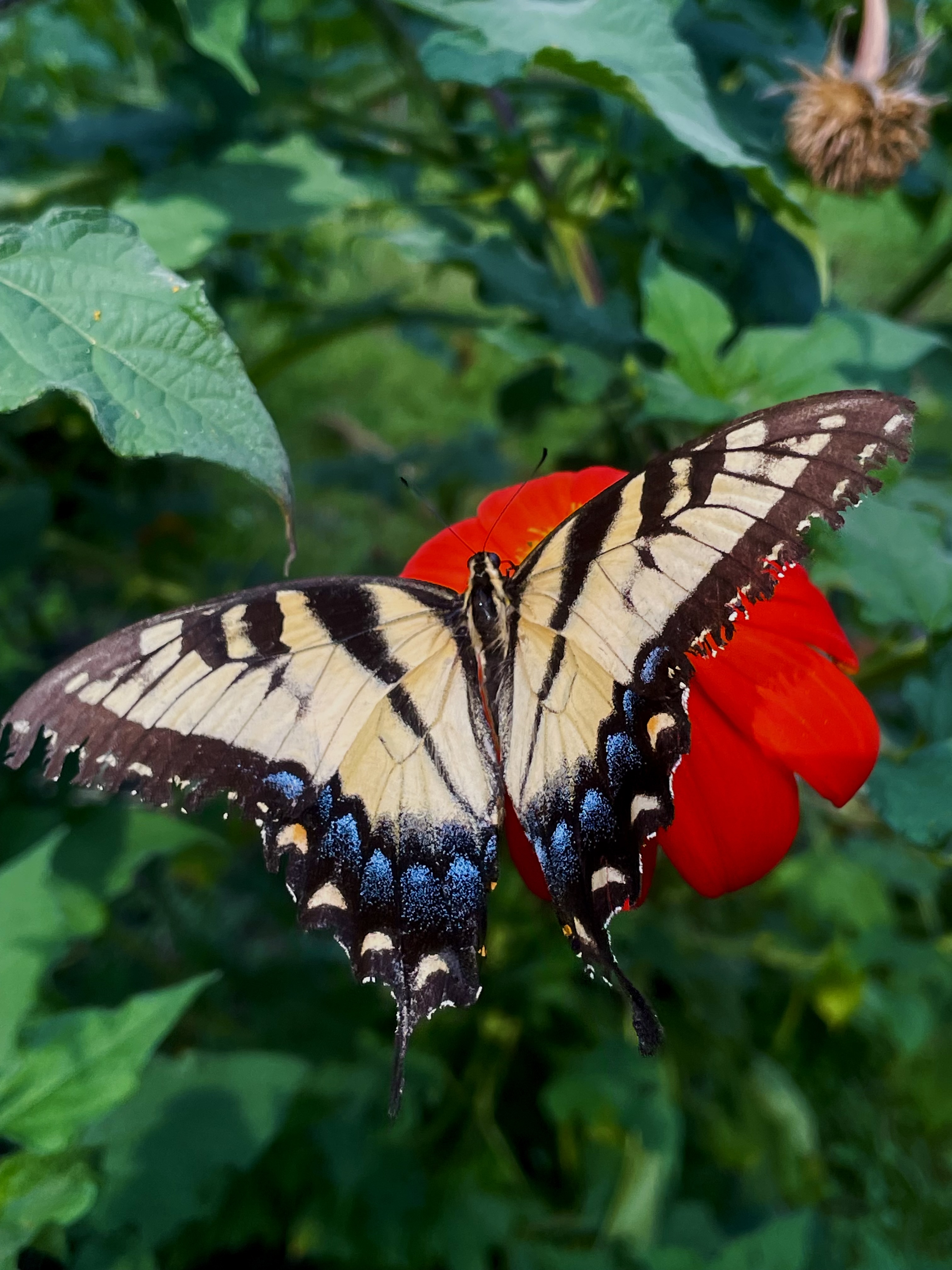
    An eastern tiger swallowtail in my backyard. (2025)

    If you’re also feeling overwhelmed at this moment, look for whales. Plant flowers. And understand that this world is still worth fighting for.

    While I have many role models, I find myself increasingly turning to the wisdom of Carl Sagan. From showcasing the wonders of the universe in Cosmos to providing us with eerily prescient warnings in The Demon-Haunted World: Science as a Candle in the Dark, his words will always be both comforting and enlightening.

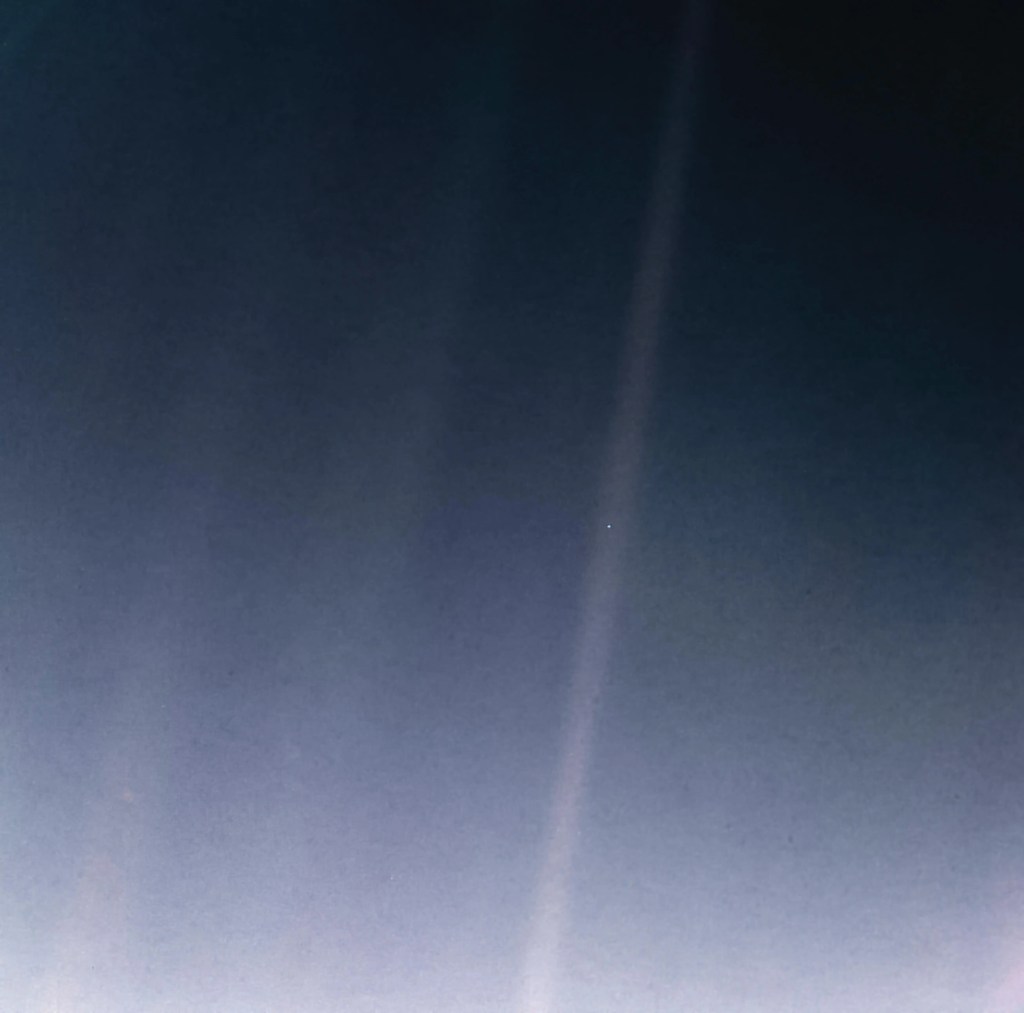
    He says it best in Pale Blue Dot:

    Look again at that dot. That’s here. That’s home. That’s us.

    On it everyone you love, everyone you know, everyone you ever heard of, every human being who ever was, lived out their lives.

    The Earth is a very small stage in a vast cosmic arena. Think of the rivers of blood spilled by all those generals and emperors so that, in glory and triumph, they could become the momentary masters of a fraction of a dot. Think of the endless cruelties visited by the inhabitants of one corner of this pixel on the scarcely distinguishable inhabitants of some other corner, how frequent their misunderstandings, how fervent their hatreds.

    Our posturings, our imagined self-importance, the delusion that we have some privileged position in the Universe, are challenged by this point of pale light. Our planet is a lonely speck in the great enveloping cosmic dark. In our obscurity, in all this vastness, there is no hint that help will come from elsewhere to save us from ourselves.

    The Earth is the only world known so far to harbor life. There is nowhere else, at least in the near future, to which our species could migrate. Like it or not, for the moment the Earth is where we make our stand.

    It has been said that astronomy is a humbling and character-building experience. There is perhaps no better demonstration of the folly of human conceits than this distant image of our tiny world. To me, it underscores our responsibility to deal more kindly with one another, and to preserve and cherish the pale blue dot, the only home we’ve ever known.

    A photo of Earth taken by Voyager 1 in 1990, 3.7 billion miles from the Sun. (NASA)

    1: In this essay, anglicized spellings such as “Hawaii” are used due to font limitations. In proper Hawaiian, these words include the ʻokina (ʻ) and kahakō (macron), which reflect the language’s pronunciation and meaning more accurately — e.g., “Hawai‘i” and “ʻaumākua.”

  • We Need to Build Viable, Third-Party Alternatives to the Corporate Duopoly 

    We Need to Build Viable, Third-Party Alternatives to the Corporate Duopoly 

    American democracy” has always been more myth than reality. The Founders were notoriously afraid of the masses and created systems like the Senate and the Electoral College to constrain their power. These systems have hardly evolved in the last couple of centuries, with some arguing that if the United States were to apply for entrance into the European Union today, the European Court of Justice would deny the application on the basis of these institutions.

    Thought experiments aside, look no further than the 2024 presidential election to witness the embodiment of everything wrong with American politics. President Joe Biden, who promised donors that “Nothing will fundamentally change” in 2019, is now working to convince Americans that only he can lead us into the bright future of tomorrow. Despite historic levels of unpopularity, uncertainty surrounding his mental capability, and growing concerns from even the most loyal of pundits, the Party has decided to fully embrace Biden while doing everything in its power to ostracize the few competitors who’ve dared question him.

    Then there’s Donald Trump, the former president who now has criminal charges against him on account of hush money payments to a porn star. From funding a genocidal war in Yemen to claiming that Democrats want to change the name of Pennsylvania, his policies and positions have ranged from the inhumane to the idiotic. While it’s fun to see a modicum of accountability come out of his recent legal troubles, hush money payments are the smallest of his crimes.

    The two candidates, their policies, and the parties they represent showcase a grim reality, particularly as they remain united in funding the ongoing genocide in Gaza, despite majority support for a ceasefire.

    The past several years have made it clear that pressure from within the current framework won’t give us anything more than empty promises. Instead, we need to support well-organized grassroots movements to create real and lasting electoral change.

    Is Three a Crowd?

    Far from just offering the option for a protest vote, third parties have a richer history in the United States than many Americans realize. In 1920, Eugene V. Debs received one million votes as a Socialist candidate in the presidential election. Notably, Debs was imprisoned at the time on account of an anti-war speech he gave a couple of years prior. Nevertheless, his message resonated with enough people to garner 3.4% of the popular vote.

    Before that, the 19th century, as a whole, was full of third parties, many of which sprang up to support specific political positions. The Greenback Party, for example, championed the antitrust movement and sent fifteen people to Congress in 1878. Similarly, the Free Soil Party formed to stop the spread of slavery to the Western territories in the 1840s. While many of these parties dissipated shortly after their conception, their impact and legacy remain.

    That said, structural barriers have always existed and remain today. Most notably, the U.S. political system operates with a winner-takes-all mentality, meaning that unless a candidate wins an outright majority of votes, they win nothing with regard to representation. This framework has led liberals, in particular, to decry third-party challengers as spoiler candidates.

    Similar barriers extend to third-party ballot access. For example, despite running on a platform that features Medicare for All, a Ceasefire in Gaza, and numerous other popular positions, Green Party candidate Jill Stein has had to overcome various bureaucratic and financial barriers to even appear on state ballots in this election. Having survived many of these obstacles, Stein (and other third party candidates) are now up against a well-oiled machine – one that has the resources to hire a “Third Party Project Manager” to allegedly infiltrate and hamper third-party efficacy.

    Multi-Partyism and Proportional Representation

    Like many aspects of the United States, our notoriously corrupt duopoly is unique among advanced democracies. Most feature multi-party systems that force political parties to work together. Building coalitions, allocating cabinet positions, and receiving endorsements from other players are all requirements for getting into office. A centrist leader, for example, may need to concede to left positions on labor and healthcare if they hope to receive sufficient support. Such a system encourages progress through camaraderie while discouraging polarization.

    Proportional representation is another element common in other governments. In such systems, multiple representatives are elected from each district, proportional to the percentage of votes the party receives. This gives smaller political parties the ability to challenge larger ones during election season, putting them in positions to influence policy once elected.

    Both multi-partyism and proportional representation contrast sharply with the U.S. duopoly, where voters often end up having to choose between a corrupt Democrat and a corrupt Republican. Besides preventing even modest pieces of legislation from passing, our system has led to record-low levels of faith in elected officials. Is it really surprising that “outside” candidates like Donald Trump (who ironically is one of the most corrupt politicians of all time) have, therefore, been able to garner so much support?

    Reject the Binary

    There’s a level of complacency palpable among most politicians these days. While Americans live paycheck to paycheck, watch the planet burn, and ask why we need to choose between two horrible presidential candidates, politicians smugly tell us to “Get over it.” When Americans question the moral implications of our taxpayer dollars going towards genocide, we’re told that the situation is more complex than we realize. Time and time again, politicians respond to genuine concerns with smugness and disdain, while begging people to continue supporting them (financially, above anything else). Let’s not kid ourselves into thinking these people care enough to get us out of these disasters. After all, they’re the ones who’ve brought us into them!

    To create an actual democracy, we need to be clear on the many flaws of our current system. There shouldn’t be parts of the country without representation in the U.S. government. Candidates shouldn’t need to spend an average of two billion dollars to be president. Lobbying groups and wealthy individuals shouldn’t have undue influence over the system. And Americans should understand that other countries don’t operate with a broken binary political system, and we shouldn’t need to either.

    I try not to judge people for how they vote, as it should only comprise a small part of civic duty. In addition to visiting a voting booth every couple of years, we need to work to overhaul our electoral systems. Proportional representation is something worth fighting for, as is expanding the power of third parties. Whether it means phone banking for an Independent or Green candidate or joining a local organization like the DSA, there are many things to be done in the short-term. Long term, our mission needs to involve ending the role money plays in politics and reforming our governmental institutions on a foundational level.

    No easy task, to be sure. But if there’s one thing these past few years have shown, it’s that we need grassroots activism to get us out of this mess. Those at the top certainly aren’t interested in doing it for us.

  • Writer Beware: Avoid the Content Mill

    Writer Beware: Avoid the Content Mill

    Like many other freelance writers, I stumbled into the industry somewhat by accident. Before COVID-19, I had been living a cushy life abroad, basking in the satisfaction of not having to update my LinkedIn. But with the start of the pandemic, I fled back home and found myself confronted with the reality of needing to find a job. 

    I spent the first half of 2020 searching, applying to everything from marketing positions to openings at local coffee shops and bookstores. Whether because of the pandemic, a lack of tangible experience, or the general state of the U.S. job market, I struggled to land anything concrete. 

    But on a random spring day, a chance conversation with a friend led me to apply for a job I’d never before considered—a freelance content writing position. My friend who worked there explained that the company always had a lot of work to offer and that as long as you hustled, you could make some decent money. 

    I applied, got accepted, and began supporting myself like half of all Americans do—by freelancing. Over time, my new writing job became my sole source of income, my mental health started to stagger, and I found myself in the grips of a trap shared by many. I was working for an exploitative content mill. 

    Content Mills 101 

    To new writers or anyone outside the industry, a content mill is a company that employs scores of freelance workers to add SEO, or search engine optimization, value to a website. 

    If Bobby’s Sweet Treats wants to attract more online traffic, it can turn to a content mill for help. The content mill will use its writers to craft SEO-optimized web copy and blog posts to satisfy Google’s algorithm. When done correctly, the Bobby’s Sweet Treats website will then show up at the top of search results. 

    While it may sound harmless, SEO is often the bane of internet users as it creates redundant and unnecessarily lengthy content. If you’ve ever read a guide or listicle that you feel like you’ve seen ten times before, it’s because you probably have.

    In terms of profit margins and business strategy, however, content mills are genius. They’re able to satisfy clients while outsourcing their work and keeping overhead costs low. Unfortunately, the hoards of freelancers they employ often see very little of the company’s success.

    The Red Pill Realization  

    Alyssa Cokinis, a freelance writer and theater artist, has a story that mirrors mine. Due to COVID-19, she found herself looking for a job and wound up working for a content mill. 

    “When I first discovered the content mill I worked at, I appreciated the diversity of topics and the general flexibility,” Alyssa says. “I could work whenever and wherever I wanted. It was a great way to supplement my income, as I was working another freelance gig and had been laid off from my more permanent position due to COVID-19.” 

    After a time, however, the magic began to wear off. Alyssa, like most freelance workers, realized that she was working for peanuts. With that realization, the veneer of excitement and opportunity started to crack. 

    “My feelings towards the content mill changed quicker than I anticipated. A freelance writer friend of mine who regularly pitches and writes for publications expressed concern at how low the rates were. That was red flag number one. Then, my mental health and concentration began to wane with each article I wrote because I would only get around $30/1000 words.” 

    Before she could fully understand what was happening, Alyssa found herself needing an escape. 

    “When you’re churning out content and you have to survive in this world, 3 cents/word is not sustainable, nor is working without any benefits,” she says. “Eventually, I had to get out and look for an hourly job just to get a regular income and not destroy my love of writing.”

    While different experts offer different advice, a general freelancing rule is to avoid taking work that pays less than 20 cents/word. Alyssa’s content mill offered 3 cents/word, and while that’s undoubtedly low, it’s still far from the bottom of the barrel. 

    On ProBlogger and other freelance job boards, it’s not uncommon to find content mills offering writers a set rate of $10/article, no matter the length. What’s most disheartening is that people take those jobs out of desperation, allowing those companies to continue their exploitative practices. 

    Making Lemons out of Lemonade  

    While content mills might try their best to take advantage of hungry freelancers, some manage to make the most of them—at least for a time. Kiki Dy is one such writer. Although she has bylines in Fodors, Psychedelic Spotlight, the Pheonix, and other publications, she continued to work for her old content mill until recently. 

    “I used to begin my work days by warming up with an hour of QC work for my old content mill,” Kiki tells me. “It was mindless, straightforward, and even a bit relaxing—until they did the classic content mill maneuver and became even more of micromanaging jerks.”

    Kiki had the strength to withstand and even make the most of an exploitative work relationship. But after a while, the company culture coupled with unreasonable demands became too much.

    “Between their infantile emoji use and corny mantras like ‘we’re a family,’ my content mill was run by a bunch of passive-aggressive people who really didn’t know anything about the craft of web copy and certainly didn’t know how much to pay us. They spoke to us like babies, would make suggestions that made the content worse, and, once they installed software that let them know how much time each writer was spending on each assignment, I decided it was no longer worth it, even for the mindless money.” 

    While she managed to turn a toxic work environment into a positive one for a while, Kiki eventually decided that it was time to leave that part of her career behind. After all, “mindless money” isn’t hard to make, and it should never come from a source that adds unnecessary stress to your life. 

    Content Mills: An Unnecessary Evil

    Working for a content mill can be a solid way to make money in the short term, especially if other job opportunities are few and far between. That said, relying on them for too long can put you on a fast track to a mental health crisis. 

    Content mills rob you of your ability to pursue other writing opportunities and force you to prioritize quantity over quality. They advertise themselves as career stepping stones, but most writers who work for them end up feeling stuck. My advice? Avoid them altogether and instead, use resources like Write Jobs Plus+.

    Times will be tough—especially if you don’t have another source of income and you’re trying to launch your career. But once you finally make it over the initial hump and find a client that meets your standards, you’ll thank yourself for not settling for less than you’re worth.