Category: Politics

  • As the Establishment Poses, the Left Builds

    As the Establishment Poses, the Left Builds

    If there’s one takeaway Americans should have in 2025, it’s that establishment Democrats are incapable – and, evidently, unwilling – to meet the moment. This year, in particular, has been rough.

    As fascism seeps deeper into the country’s foundation, leading Democrats have responded by embarking on Sorry I Lost book tours, snapping plastic crowns, and putting on rhetorical performances. At the same time, they’re posing with war criminal Benjamin Netanyahu, short-circuiting when asked about AIPAC donations, and acquiescing to the same policies they’re decrying. 

    Fortunately, while the rot is clear, so too is the path forward.

    A year ago, Zohran Mamdani was an unknown figure, polling at 1%. This past week, he was elected mayor of New York City and has become one of the most recognizable faces of a movement determined to resist the pervasive hatred, greed, and ignorance of our times. His victory confirmed what many on the Left already knew – that the path forward isn’t through theater masquerading as politics, but through a relentless, grassroots fight for the betterment of the working-class. A movement grounded in material benefits – not symbolic gestures – is one built to win. 

    And while Mamdani is an inspiring figure, his success isn’t the only victory worth celebrating from this past week. In Atlanta, Kelsea Bond’s campaign for District 2’s City Council seat similarly built up enough grassroots energy to win a commanding victory.

    The Fight for The City in a Forest

    Bond’s platform shares much in common with Mamdani’s, with both centering the building of a liveable city through affordable housing, sustainable infrastructure, and an expansion of workers’ rights. Like Mamdani’s, Bond’s campaign knocked on thousands of doors and received endorsements from the Working Families Party, local unions, and numerous other organizations and figures. 

    Bond’s platform is also rooted in urgency, as the past several years have been difficult for Atlanta. Despite fierce resistance from organizers and over 100,000 residents calling for a referendum, city leaders approved Cop City (officially the Atlanta Public Safety Training Center), and the facility opened this past April. On top of such blatantly undemocratic decision-making, citizens have also been dealing with an affordability crisis as local rent prices soar and wages stagnate. This has forced long-term residents out of areas like Bond’s District 2, while Atlanta’s fractured transportation network and abhorrent traffic – the fifth worst in the country – have made their exodus permanent.

    Community Building Through Resistance

    On the Wednesday before their victory, Bond’s vision came into focus during a panel with Daniel Aldana Cohen, coauthor of A Planet to Win: Why We Need a Green New Deal, and Elise Joshi, a fellow activist and organizer. Throughout the hour-long conversation, Bond spoke on their motivations and articulated how their platform seeks to connect climate action to housing, public transit, and civic power.

    “For so many young people in Atlanta, [Cop City] really demonstrated the lack of democratic processes that exist in Atlanta politics,” they said. “People can see the contradictions that exist in the Atlanta government, and that’s contributed to the energy around our campaign.”

    While city councilors fight for local change, the issues they combat often mirror national dynamics. Bond spoke to this, highlighting how establishment politicians often work together to protect capital, regardless of party.

    “In an ideal situation, we would form a Big Tent alliance against fascism in the Trump regime,” Bond said. “Instead, we’re seeing the Atlanta establishment – traditionally centrist Democrats – aligning themselves with Republican City Council members and throwing progressives under the bus.”

    In the face of such collusion, grassroots movements provide hope, but they also offer a less-discussed benefit. As the loneliness epidemic worsens and society, at large, fractures, organizing can help alleviate atomization. Bond addressed this, emphasizing that community-building was foundational to their campaign.

    “I learned very early on in organizing that people will not stick around if they’re not having fun,” they said. “That’s why it’s been so crucial since the launch of our campaign to keep [our movement] fun and ensure that people are making friends and connecting with new people.”

    Cohen agreed, quipping that phones are like tiny suburbs in our pockets – isolating, yet for many people, the only way they experience politics.

    While extensive canvassing efforts helped propel Bond to victory, their campaign also hosted concerts and comedy shows to foster community. These helped break down social silos – which can often feel entrenched in Atlanta, due to its car-centric infrastructure – while working to tackle the city’s chronically low municipal turnout. 

    “I grew up in the DIY music scene in Atlanta, and I know they’re all left-wing. I know they’re all mad at our city government for Cop City. And so, we’ve really been trying to tap into those spaces to bring people in who otherwise wouldn’t see any reason to vote.”

    Whether or not fed-up indie artists were the deciding factor, Bond’s campaign tactics proved more than just successful. 6,715 local residents voted for them, earning a 64% victory and avoiding a potential runoff.

    And what did Bond’s supporters vote for? Density – not as a buzzword or a piece of urbanist jargon, but as scaffolding to help connect people to their communities. 

    “Every single person deserves to live close to where they work, not just to improve the quality of their life, but because it makes it easier to organize in your community,” Bond said. “It makes it easier to be civically engaged. It makes it easier to plan a meeting with your coworkers when you don’t have to drive an hour to meet at the same place.”

    Beyond District 2

    While Atlanta may not have a democratic socialist mayor (yet!), Kelsea Bond’s city council win is one the Left should celebrate. Like Zohran Mamdani, Bond ran an inspiring grassroots campaign, and their victory serves as a much-needed reminder that progressive forces can win when they fight for commonsense policies, work to repair fractured communities, and offer voters genuine hope. 

    At a time when national politics have rarely felt more hollow – when centrists pose and flounder against cartoonishly evil forces – Bond’s blueprint to success is one worth emulating.

  • We Need to Build Viable, Third-Party Alternatives to the Corporate Duopoly 

    We Need to Build Viable, Third-Party Alternatives to the Corporate Duopoly 

    American democracy” has always been more myth than reality. The Founders were notoriously afraid of the masses and created systems like the Senate and the Electoral College to constrain their power. These systems have hardly evolved in the last couple of centuries, with some arguing that if the United States were to apply for entrance into the European Union today, the European Court of Justice would deny the application on the basis of these institutions.

    Thought experiments aside, look no further than the 2024 presidential election to witness the embodiment of everything wrong with American politics. President Joe Biden, who promised donors that “Nothing will fundamentally change” in 2019, is now working to convince Americans that only he can lead us into the bright future of tomorrow. Despite historic levels of unpopularity, uncertainty surrounding his mental capability, and growing concerns from even the most loyal of pundits, the Party has decided to fully embrace Biden while doing everything in its power to ostracize the few competitors who’ve dared question him.

    Then there’s Donald Trump, the former president who now has criminal charges against him on account of hush money payments to a porn star. From funding a genocidal war in Yemen to claiming that Democrats want to change the name of Pennsylvania, his policies and positions have ranged from the inhumane to the idiotic. While it’s fun to see a modicum of accountability come out of his recent legal troubles, hush money payments are the smallest of his crimes.

    The two candidates, their policies, and the parties they represent showcase a grim reality, particularly as they remain united in funding the ongoing genocide in Gaza, despite majority support for a ceasefire.

    The past several years have made it clear that pressure from within the current framework won’t give us anything more than empty promises. Instead, we need to support well-organized grassroots movements to create real and lasting electoral change.

    Is Three a Crowd?

    Far from just offering the option for a protest vote, third parties have a richer history in the United States than many Americans realize. In 1920, Eugene V. Debs received one million votes as a Socialist candidate in the presidential election. Notably, Debs was imprisoned at the time on account of an anti-war speech he gave a couple of years prior. Nevertheless, his message resonated with enough people to garner 3.4% of the popular vote.

    Before that, the 19th century, as a whole, was full of third parties, many of which sprang up to support specific political positions. The Greenback Party, for example, championed the antitrust movement and sent fifteen people to Congress in 1878. Similarly, the Free Soil Party formed to stop the spread of slavery to the Western territories in the 1840s. While many of these parties dissipated shortly after their conception, their impact and legacy remain.

    That said, structural barriers have always existed and remain today. Most notably, the U.S. political system operates with a winner-takes-all mentality, meaning that unless a candidate wins an outright majority of votes, they win nothing with regard to representation. This framework has led liberals, in particular, to decry third-party challengers as spoiler candidates.

    Similar barriers extend to third-party ballot access. For example, despite running on a platform that features Medicare for All, a Ceasefire in Gaza, and numerous other popular positions, Green Party candidate Jill Stein has had to overcome various bureaucratic and financial barriers to even appear on state ballots in this election. Having survived many of these obstacles, Stein (and other third party candidates) are now up against a well-oiled machine – one that has the resources to hire a “Third Party Project Manager” to allegedly infiltrate and hamper third-party efficacy.

    Multi-Partyism and Proportional Representation

    Like many aspects of the United States, our notoriously corrupt duopoly is unique among advanced democracies. Most feature multi-party systems that force political parties to work together. Building coalitions, allocating cabinet positions, and receiving endorsements from other players are all requirements for getting into office. A centrist leader, for example, may need to concede to left positions on labor and healthcare if they hope to receive sufficient support. Such a system encourages progress through camaraderie while discouraging polarization.

    Proportional representation is another element common in other governments. In such systems, multiple representatives are elected from each district, proportional to the percentage of votes the party receives. This gives smaller political parties the ability to challenge larger ones during election season, putting them in positions to influence policy once elected.

    Both multi-partyism and proportional representation contrast sharply with the U.S. duopoly, where voters often end up having to choose between a corrupt Democrat and a corrupt Republican. Besides preventing even modest pieces of legislation from passing, our system has led to record-low levels of faith in elected officials. Is it really surprising that “outside” candidates like Donald Trump (who ironically is one of the most corrupt politicians of all time) have, therefore, been able to garner so much support?

    Reject the Binary

    There’s a level of complacency palpable among most politicians these days. While Americans live paycheck to paycheck, watch the planet burn, and ask why we need to choose between two horrible presidential candidates, politicians smugly tell us to “Get over it.” When Americans question the moral implications of our taxpayer dollars going towards genocide, we’re told that the situation is more complex than we realize. Time and time again, politicians respond to genuine concerns with smugness and disdain, while begging people to continue supporting them (financially, above anything else). Let’s not kid ourselves into thinking these people care enough to get us out of these disasters. After all, they’re the ones who’ve brought us into them!

    To create an actual democracy, we need to be clear on the many flaws of our current system. There shouldn’t be parts of the country without representation in the U.S. government. Candidates shouldn’t need to spend an average of two billion dollars to be president. Lobbying groups and wealthy individuals shouldn’t have undue influence over the system. And Americans should understand that other countries don’t operate with a broken binary political system, and we shouldn’t need to either.

    I try not to judge people for how they vote, as it should only comprise a small part of civic duty. In addition to visiting a voting booth every couple of years, we need to work to overhaul our electoral systems. Proportional representation is something worth fighting for, as is expanding the power of third parties. Whether it means phone banking for an Independent or Green candidate or joining a local organization like the DSA, there are many things to be done in the short-term. Long term, our mission needs to involve ending the role money plays in politics and reforming our governmental institutions on a foundational level.

    No easy task, to be sure. But if there’s one thing these past few years have shown, it’s that we need grassroots activism to get us out of this mess. Those at the top certainly aren’t interested in doing it for us.

  • The Chinese People Are Pushing Back Against Authoritarianism. They Deserve Our Support.

    The Chinese People Are Pushing Back Against Authoritarianism. They Deserve Our Support.

    Over the past several days, images and videos have come out of different parts of China showing what happens when you push people to their limits. Undeterred by censorship, the threat of arbitrary arrest and detention, and a host of other possible consequences, thousands of people marched through the streets of different cities to protest zero-COVID restrictions. With chants of “Freedom, freedom, freedom (自由,自由,自由),” “Fuck you, health code (操你妈,健康码),” and “Step down [Chinese Community Party] (戏台),” the protests provide some insight into the frustrations that many have begun to feel towards the government. 

    It’s difficult to express how significant these protests are. While distance and intense censorship make supporting those protesting a challenge, drawing international attention to what’s happening and offering our solidarity is the least we can do. 

    Rising Tensions

    China has kept its zero-COVID policy going for almost three years. While other countries like the United States have made living with COVID their official policy (with admittedly mixed results), China has held onto the idea of containing outbreaks before they can spread. Early on, this made sense, and while the draconian tactics employed were extreme, China did largely succeed in keeping COVID cases down, despite having the largest population in the world. However, as variants have become weaker yet more transmissible, numbers have climbed despite the measures, causing resentment to grow with them. 

    Reported COVID-19 cases in China, according to worldometers.info.

    In late March and April of this year, an outbreak in Shanghai caused the government to lock down several districts of the city. Residents were ordered to stay in their homes and weren’t allowed to leave for any reason, including to buy essentials. Many citizens experienced food shortages, while people who tested positive (including children) were taken to isolation centers. While this past spring represented a low point for public sentiment toward the restrictions, resentment has boiled over again in recent weeks in cities like Guangzhou and Beijing.

    Far from acknowledging this resentment, the government has doubled down on zero-COVID, further tightening restrictions in several cities as cases rise once again. In a government meeting earlier this month, Xi Jinping clarified that China will “unswervingly adhere” to its current policy. 

    The Powder Keg Blows

    On Thursday, November 24th, a fire broke out on the 15th floor of an apartment building in Urumqi, the capital city of China’s Xinjiang province. As the blaze spread to other floors, state media reported that it killed ten people, but local reports claim that as many as 40 people died. Images and videos appear to show locked fire exits and other barriers preventing people from vacating the building, exacerbating the severity of the crisis. At the same time, fire trucks were unable to get close enough to the building to extinguish the blaze, as fences and other obstructions had kept residents on a strict lockdown for months. 

    Fire trucks unable to reach the blaze in Urumqi.

    Xinjiang (pronounced Shin-jaang) is often in the news as it’s home to the Uyghur people, a Chinese ethnic minority. Uyghurs are culturally different from the Han majority, being primarily Muslim and speaking a Turkic language. Far from embracing this multiculturalism, the Chinese government has committed widespread human rights abuses against Uyghurs since separatist movements led to conflict in Xinjiang decades ago. Reports and testimonies indicate that the government has detained around one million Uyghurs in internment camps. They also point to other crimes, including slave labortortureseparation of children from their parentsenforced sterilization, and disappearances

    Xinjiang, China’s northwesternmost province.

    On a personal level, I met an incredible Uyghur woman in Shanghai who has since managed to emigrate out of China. She told me that her dad works as a university professor and that he often has to stay in the dormitories for weeks at a time while students’ parents are at reeducation camps. She also said that her mom was arrested once in the middle of the night during a random raid and taken in for questioning. 

    After my friend decided to move to another city in China, police and party officials interrogated her weekly to test her loyalty and assess whether she was a threat. Likewise, a camera was also installed outside of her apartment door to monitor her, while her dream job of working with a foreign company fell through when someone spread rumors that she was a terrorist. To say that she’s had a difficult life would be an understatement. Sadly, her story and experiences seem to be representative of what many Uyghurs, particularly those unable to leave Xinjiang, go through. 

    Unsurprisingly, the Chinese government works hard to ensure that these sorts of stories and reports don’t make it out of Xinjiang. But while many Chinese might not be aware of what’s happening in the province, zero-COVID policies leading to deteriorating social conditions and unnecessary deaths are things they can understand clearly.

    What the Protests Look Like

    Since the fire broke out, protests and vigils have taken place in Urumqi, Shanghai, Beijing, Guangzhou, Nanjing, Wuhan, Chengdu, and presumably other cities and universities across the country. While some of the participants are there to commemorate those that died in the fire, others are going further, criticizing zero-COVID and the government, in general. In a society that doesn’t allow any form of political dissidence, this is remarkable. 

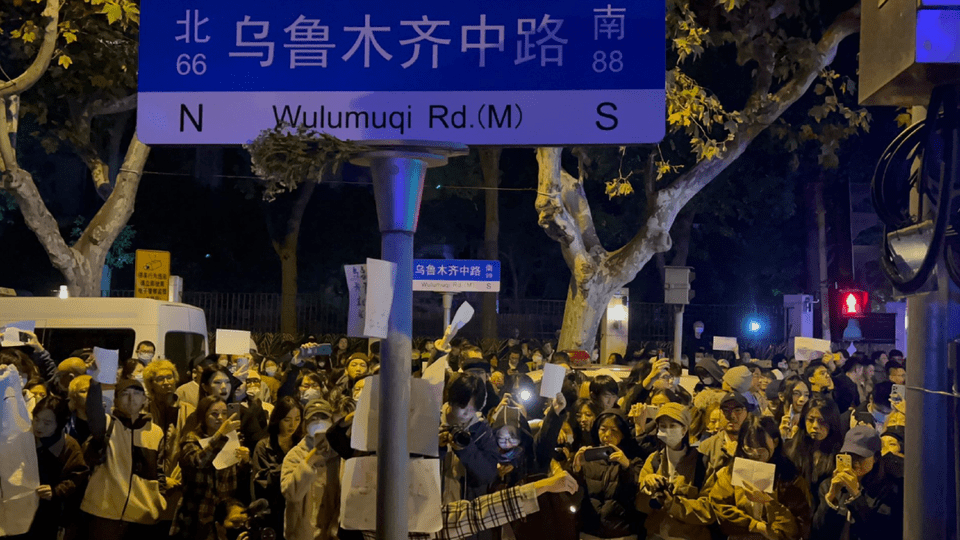
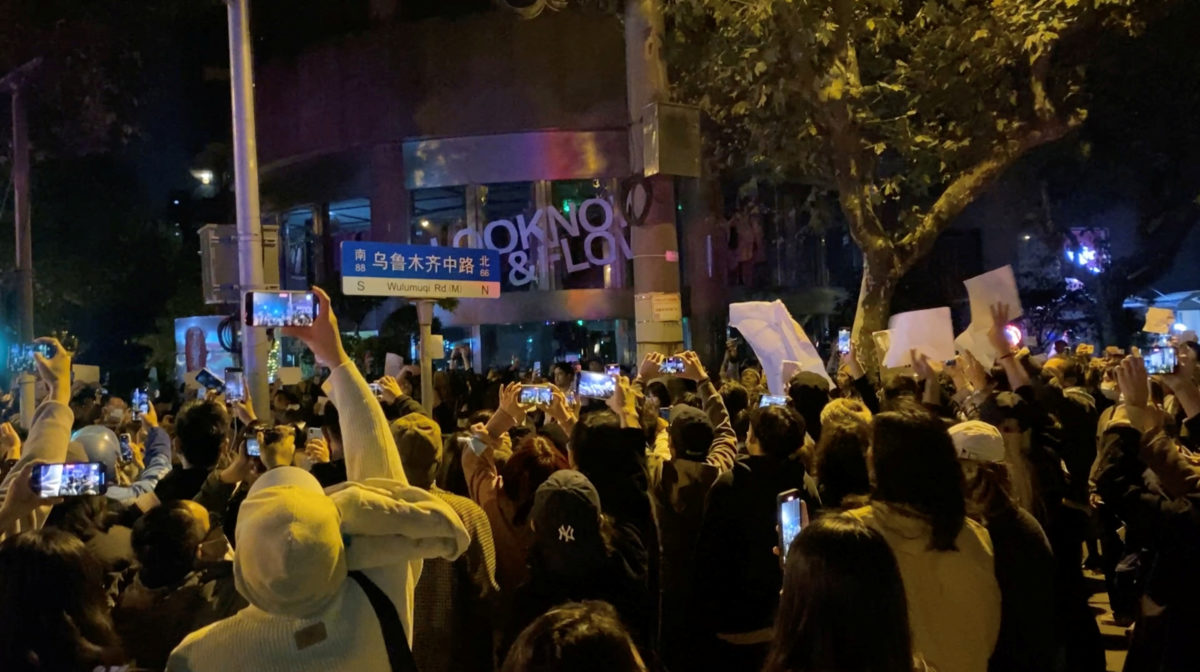
    Crowds of people protesting at Urumqi Road, Shanghai.

    In Shanghai, thousands gathered at Urumqi Road, just a couple of blocks away from where I lived. From ending censorship and holding those responsible for the Urumqi disaster accountable to demanding an end to dictatorships and Xi Jinping’s rule, the protests are of a magnitude that China hasn’t seen for decades. Some also sang revolutionary songs, including the Chinese National Anthem, “March of the Volunteers,” which goes as follows:

    Arise, ye who refuse to be slaves!

    With our flesh and blood, let us build a new Great Wall!

    As China faces its greatest peril

    From each one the urgent call to action comes forth.

    Arise! Arise! Arise!

    Millions of but one heart

    Braving the enemies’ fire! March on!

    Braving the enemies’ fire! March on!

    March on! March, march on!

    (起来!不愿做奴隶的人们!

    把我们的血肉,筑成我们新的长城!

    中华民族到了最危险的时候,

    每个人被迫着发出最后的吼声。

    起来!起来!起来!

    我们万众一心,

    冒着敌人的炮火,前进!

    冒着敌人的炮火,前进!

    前进!前进!进!)

    While the protests have been peaceful, the state’s response to them hasn’t. In Shanghai, one video posted on social media shows police beating and dragging a protester away, while crowds of people try to save him. Another video posted on WeChat shows an officer striking a female protester across the face as she’s detained on a police bus while yelling “I just can’t stand the people [I serve] (我只是看不惯你们这些人民群众).” 

    Universities in Nanjing and other cities have begun to preemptively close in an effort to keep the protests from growing. Many in power fear that the current momentum will lead to another 1989 incident, which culminated in the student-led Tiananmen Square protest and led to the death of hundreds, if not thousands. As the current movement appears to be gaining momentum, the state’s crackdown on it will continue to increase. 

    Knowledge Is Power

    China is something of an enigma to many Americans, with Western media often painting it as a horrific place. While censorship, arbitrary detainment, and outright genocide showcase how inhumanely politicians can behave, it’s essential to distinguish between a country’s government and its people. In the three years I lived in China, I found the people to be some of the warmest and most welcoming in the world. They, like all ordinary people, desire the same basic things: health, happiness, and security for their loved ones. 

    When COVID-19 first broke out, the Chinese government arrested doctors who tried to bring attention to the crisis. The death of one of those doctors, Dr. Li Wenliang, galvanized people, causing them to begin demanding answers on Weibo, a Chinese platform similar to Twitter. On February 6th, 2020, after questioning what happened to Dr. Li, “Freedom of Speech (言论自由)” began to trend as well. While the government blocked the hashtag later that morning, there’s a powerful takeaway from that moment. While we can’t underestimate the lengths the Chinese government will take to hold onto power, we also can’t discount the rightful anger that the people feel and are capable of expressing. 

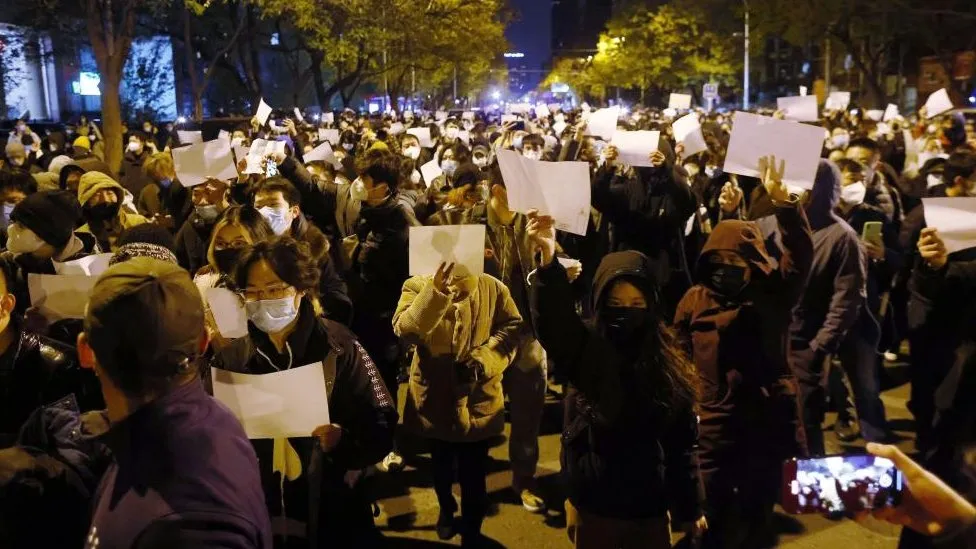
    Protesters holding white papers to symbolize an end to censorship in Beijing.

    We have a tendency to not concern ourselves with what goes on in other parts of the world. From distant wars and famine to climate disasters and elections, it’s easy to forget that what we watch on the news involves human lives, and ultimately, our own as well. In this case, I fear that while much of the world may learn about what’s happening in the streets of Shanghai and other Chinese cities, international action may not follow. 

    You won’t find a GoFundMe you can donate to, nor do I think there’ll ever be a trendy graphic you can add to your profile picture to show support à la the French flags that took over Facebook in 2015. But understanding what’s happening in China is the first step to helping change take place. This past August, after years of campaigning by human rights groups, the United Nations issued a report condemning China’s actions in Xinjiang. While that doesn’t magically resolve things, it does add fuel to the push to end the crimes against humanity taking place.

    Vigils have begun popping up for the victims of the Urumqi fire in New York, Tokyo, Paris, and other cities around the world. Short of attending one of these events in your area, staying informed and helping those around you understand what’s happening are the next best things you can do. Right now, the Chinese people need our unconditional support. As with any group pushing back against injustice, offering our support in the ways we can is the least we can do. 

  • The Shameful History of U.S Relations with Haiti

    The Shameful History of U.S Relations with Haiti

    As is the norm in the modern-day news cycle, there have been many unsettling images floating around as of late. From chaos in Afghanistan to wildfires tearing across the world, it’s easy to become numb to the events happening around us. However, if there’s one image that should stand out in everyone’s mind, it’s U.S. Border Patrol agents chasing Haitian migrants around on horses.  

    What makes this scene so unsettling isn’t the complete lack of empathy shown towards people escaping unimaginable horrors. Nor is it the depressing reality that the southern border is becoming increasingly militarized—often in ways that violate basic human rights.

    It’s the fact that the actions of the United States have led to the dire situation in Haiti today. And instead of accepting that and helping the men, women, and children in need of desperate and immediate assistance, the U.S. continues to treat them as inhumanely as possible. 

    The history of Haiti is full of tragedy, but it’s also full of hope. Through understanding it, it becomes clear that the U.S. shouldn’t just help the Haitian people. It owes them its support.

    Colonial Origins

    Christopher Columbus was the first European to arrive on Hispaniola, the island that contains the present-day countries of Haiti and the Dominican Republic. Upon arrival, he found a region occupied by advanced and complex native societies—societies which he, and others, quickly began to dismantle. 

    Through this destruction, Hispaniola became one of the first Spanish colonies in the Caribbean. During the 16th century, it even served as a staging point for expeditions to Mexico and other parts of the Americas. 

    Within a few decades, warfare, enslavement, and disease had killed nearly all native Taino people. This forced the Spanish to turn to a new labor source: African slaves. The first enslaved people reached the Americas via Hispaniola in 1502. The Atlantic slave trade would continue for hundreds of years after, condemning millions of people to a life in chains.

    French Occupation

    Towards the latter half of the 17th century, Spanish power and influence in the Americas began to wane. As other European forces began to grow stronger, Spain chose to relinquish part of Hispaniola to France. In 1659, the French founded the colony of Sainte-Domingue on the west side of the island. 

    Over the next century, the French colony became extraordinarily rich. Slave labor supplied European countries with coffee and sugar—delicacies that they couldn’t get enough of. By the end of the 18th century, around 500-700,000 slaves toiled away on French plantations.

    Slave rebellions had occurred throughout the 18th century, but it wasn’t until the French Revolution began in 1789 that slaves and free people of color launched the Haitian Revolution. More than a decade later in 1804, they finally achieved victory. They chose to name their new country Haiti, which meant mountainous in the indigenous language.

    Post-Colonial Legacy

    Unsurprisingly, the early years were difficult for the newly independent island nation. Internal strife threatened to tear the republic apart, and conflicts with the neighboring Dominican Republic persisted until the 1870s. On top of this domestic turmoil, the rest of the world continued to eye the riches of Haiti. To access them, they began vying for control over the country. 

    Through marriages, public development, and high-interest loans, Germany managed to gain an influential hold over Haiti in the late 19th century. Soon after, it began trying to exert influence over the rest of the Caribbean. 

    These power grabs angered the United States, which saw German influence as a threat to its economic activity in the Western Hemisphere. To protect American businesses, the U.S. bought out the Haitian national bank, then transferred the country’s gold reserves to the banks of American investors. To further protect its financial interests, the U.S. also helped Jean Vilbrun Guillaume Sam become president in 1915. 

    Sam, an army commander, quickly became a dictator, executing hundreds of political prisoners. His actions enraged the Haitian people, and in July of 1915, a mob rose in revolt. Despite seeking refuge in the French embassy, the rebels broke in and killed him.

    This incident served as the excuse the U.S. needed to take a more direct role in the island nation’s affairs.

    20th-Century Imperialism

    On July 25th, 1915, U.S. President Woodrow Wilson sent 330 marines to seize control of Port-au-Prince. He also took measures to rewrite the Constitution in a way that protected U.S. financial control over the island.

    In response, several Haitian groups rose in revolt, plunging Haiti into a period known as the Caco Wars (Caco being the peasant militia that composed the majority of the rebellious bands). The skirmishes and battles the U.S. occupation brought to the island didn’t end until 1934, when the marines left. 

    In September of 1915, the U.S. created the Haitian-American Convention. This treaty gave the United States complete control over the security and economic wellbeing of the island. It also provided the U.S. government with veto power over all parts of the Haitian government, effectively converting the country into an American puppet. 

    Six weeks after the start of the occupation, U.S. forces also seized control of Haiti’s banks and treasuries. To further protect its economic interests, the U.S. mandated that 40% of Haiti’s national income went to repay American and French debts. This direct control over Haitian finances continued until 1947.

    Recent Developments

    Despite occurring less than a century ago, it’s tempting to sweep these atrocities under the rug and classify them as ancient history. Unfortunately, U.S. destabilization efforts have continued to this day.

    At the height of the Red Scare, the U.S. threw itself into two major conflicts: the Korean War in the early 1950s and the Vietnam War a decade later. However, in an effort to stop the spread of communism, the U.S. secretly funded anti-communist parties in dozens of countries, triggering coups and violent revolutions in countries as far apart as Chile and Iran. Haiti wasn’t spared. 

    In 1957, the U.S. chose to support a Haitian dictator: Francois Duvalier. He and his son ruled Haiti with a solid anti-communist stance until the 1990s, when uprisings ended their rule. Haiti then elected a democratic leader, Jean Bertrand-Aristide, but less than a year later, a coup toppled the newly-elected leader’s government. Unsurprisingly, leaders and insurgents received funding from the CIA. 

    In 2001, Aristide came to power once again, but soon after, another coup forced him out of office. After that, in 2010, the Obama Administration pressured a popular presidential candidate, Jude Celestin, to withdraw from the Haitian national election. 

    Since then, earthquakes and other natural disasters have further battered Haiti. In August of this year, a magnitude 7.2 earthquake struck the country, killing thousands and causing over $1 billion in damage. That, along with another suspicious coup that occurred in July, caused the latest “migrant crisis.”

    The Viral Moment

    While the U.S. government may have been able to get away with atrocities in the past, times have changed. Today, modern technology makes it easier than ever to showcase horrors that would previously have occurred in secret, especially those happening inside the country. Anyone with a television or smartphone can now see how the United States treats people fleeing the devastation it has caused.

    It wasn’t all horses, however—many asylum-seeking Haitians also received a warm verbal welcome:

    “¡Vete a México!”

    “Hey! You use your women? This is why your country is shit, because you use your women for this.”

    In a video put out by Al Jazeera, a migrant named Nicolas explains that many migrants are trying to carry food, sanitary supplies, and medicine from Mexico to their families on the U.S. side of the border. He explains that they have absolutely nothing. He and the reporter also discuss how the U.S. is sending planes full of asylum-seekers back to Haiti. Nicolas explains:

    “What kills me about that is that everyone knows what we Haitians are going through. There’s no president. Crime is high. Students can’t go to school. There’s no work. The economy is down. People can’t put up with that.” 

    Would anyone be able to?

    Two Parties, One Approach

    If the 45th president of the United States was famous (or infamous) for anything, it was his harsh stance on immigration. 

    In 2018, the Trump Administration began the policy of separating children from their parents. In total, 4,368 children were taken and held in cages. There were no adult caretakers present, little to no nutritious food offered, and no opportunity to get clean clothes or bathe.

    In March of last year, the Trump Administration passed Title 42, a law that allows the U.S. Border Patrol and U.S. Customs to turn away people who pose a “health risk.” While that might sound like a fair call to make during a pandemic, immigrant rights groups have explained that Title 42 is nothing more than another attempt to block land entry for migrants. Health officials have also spoken out against it, clarifying that migrants are in no way driving a COVID-19 surge. 

    When these sorts of news stories broke (as they did quite often), Democratic leadership was rightfully losing its mind, as were human rights groups across the country and the world. Throughout 2020, Joe Biden and other presidential candidates spoke about how inhumane the Trump Administration’s immigration policy was and promised to go in a different direction once in office. 

    So you can imagine the horror felt by human rights groups worldwide when the Biden Administration didn’t end Title 42. To this day, they continue to use it to expel migrants at a faster rate than the Trump Administration ever did. So much for open borders. 

    Likewise, child jail cells have become “migrant facilities for children.” No matter how many disturbing photos find their way out of these centers, the Biden Administration continues to claim (with a straight face) that they care about immigrant wellbeing.

    The Modern Duopoly

    So what gives? How can Democratic politicians claim one thing, then act in a way that completely contradicts what they just said? 

    It’s because despite what the mainstream media might have you believe, there isn’t much difference between modern Democrats and Republicans. Both support a capitalist system that prioritizes corporate wants over constituent needs. Both seem oblivious to the imminent threat of climate change. And, as the viral videos over the past few weeks show, both continue to support a draconian immigration system that fundamentally contradicts the supposed values of the United States.

    While Republican politicians like Donald Trump, Greg Abbott, and Ron DeSantis give press briefings explaining how dirty migrants are bringing COVID, Democratic leadership operates a bit differently. Instead of linking immigrants to diseases and financial ruin, Press Secretary Jen Psaki promises a room full of concerned journalists that the administration will do better and that from this point on, local Border Patrol agents will no longer ride horses. Thank God! 

    Moments such as these highlight the absurdity of the current political duopoly. While Republican and Democratic politicians may disagree on decorum and surface-level details, their actions show that they’re largely the same. Both parties have a track record of raising a middle finger to Haitians and other immigrants for decades.

    What the Haitian People Need

    After centuries of foreign meddling, robbery, and outright slaughter, the Haitian migrants at the border deserve so much more than a one-way ticket back home. They deserve the same opportunities that people from other parts of the world have enjoyed for centuries.

    At the same time, leaders from the United States (and yes, other nations like Spain and France) need to take a serious look at how their actions have led to the situation in Haiti today. The Haitian people there need immediate assistance, and, as the United States is the wealthiest country on Earth, we can easily provide it to them.

    After everything the U.S. has done to the world’s oldest black republic, lending a helping hand is the least we can do.

    Keep Reading